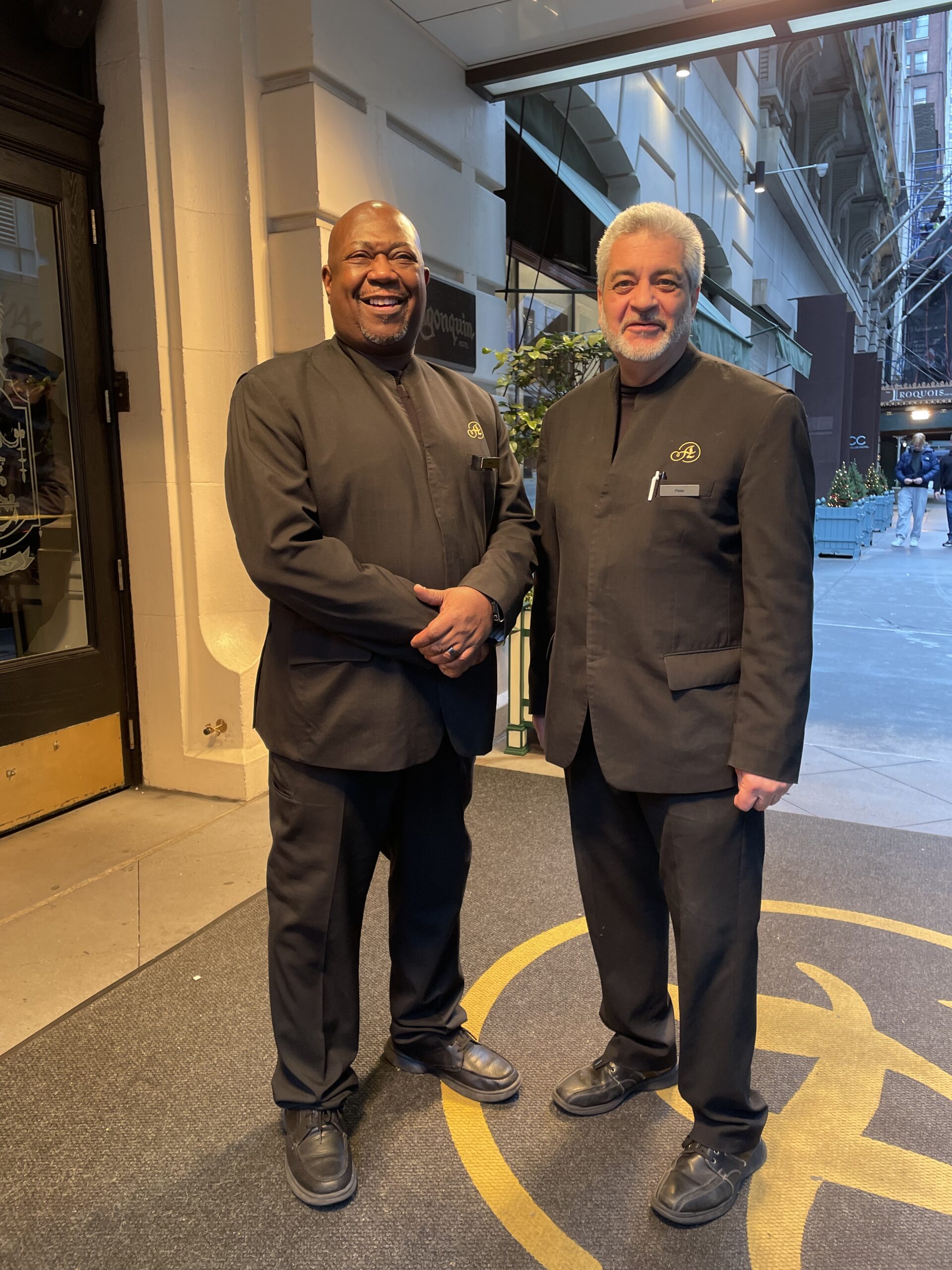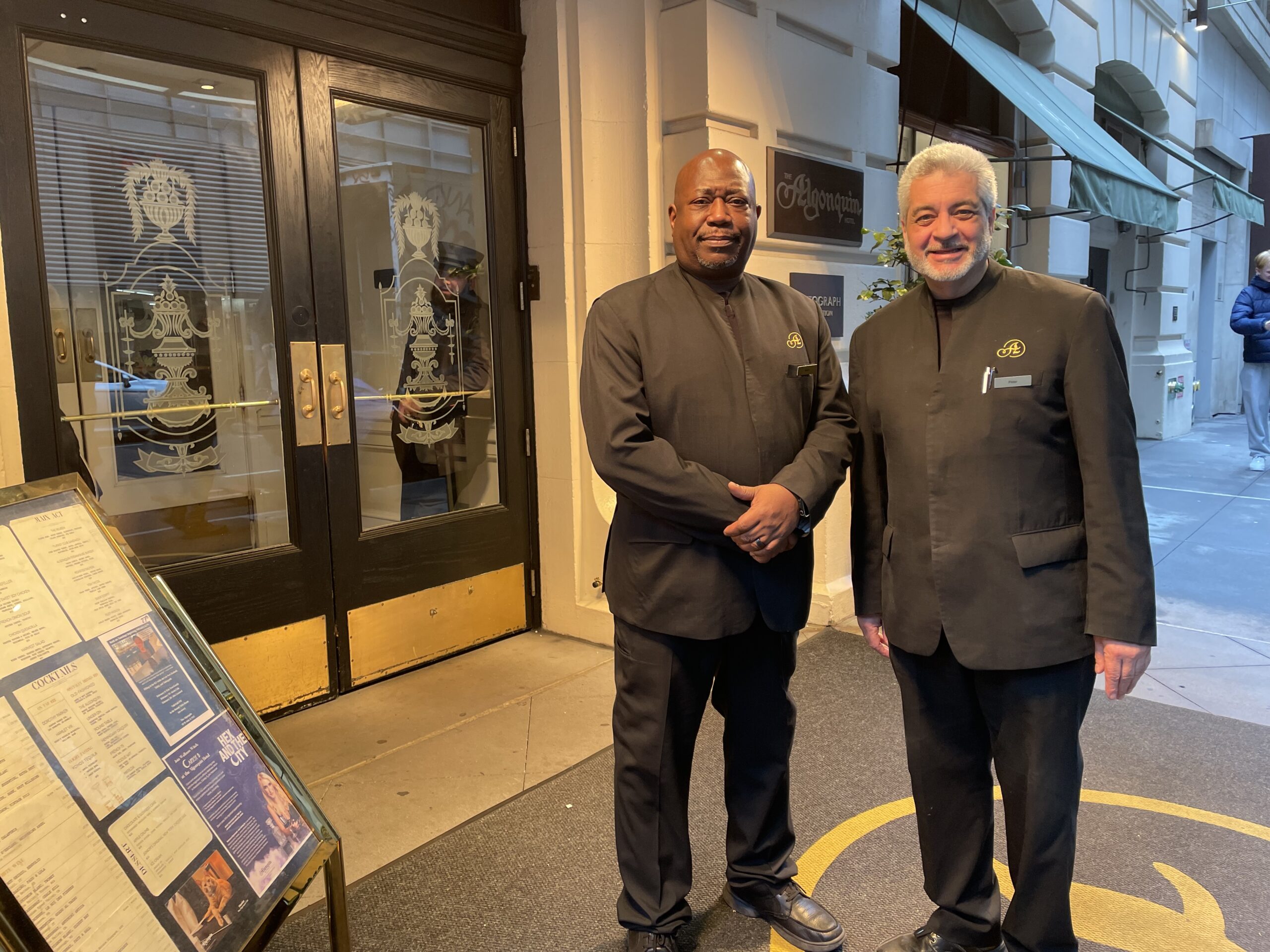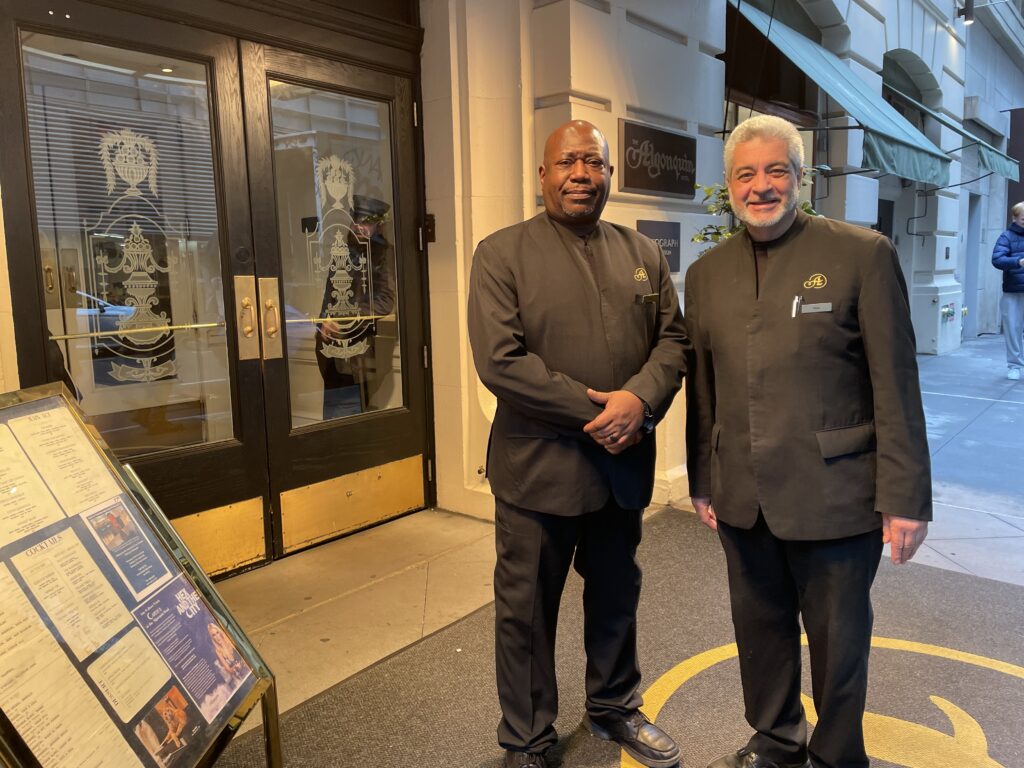
Kevin Wilkes and Peter Cruz.
Visitors to the
Algonquin Hotel will no longer see two of the legendary personalities greeting all visitors to the front door. On February 2, veteran doormen Peter Cruz and Kevin Wilkes retired on the same day together. At the Algonquin, Kevin had 32 years of service and Peter 46 years. The day before, the staff held a grand surprise retirement party for the pair in the Oak Room.
I caught up with them at their usual spot in the lobby, greeting guests, grabbing luggage, holding the doors open, and smiling and saying hello to all.
Peter started in the “back of the house” in the kitchen not long after his student days at LaGuardia High School for Music and Art. He was born on the Bowery to parents who had immigrated from Puerto Rico. Kevin is also a native New Yorker and an alum of Thomas Jefferson High in New Lots, Brooklyn.
The interview is edited and condensed for clarity.
Question: When did you guys start?
Kevin: 1992.
Question: What were you doing before you came here?
Kevin: Same thing, I actually worked over at the Drake Hotel.
Question: And how’d you get the job here?
Kevin: Where I worked it was slow over there and I went over to the union to try to get something, like a temporary (position), and they told me about this hotel. The personnel manager that worked at the Drake Hotel was at the Algonquin. They said, “I think you might know him. Go over.” Because it was only supposed to be a temp job because one of the guys had hurt his back or something. So, he was out for six months. It was like, “Well Kevin, this might just be a six-month thing.” And then once I came in, they were like, “Listen, he’s not coming back. You’re going to be here.” And I have been here ever since then. It was supposed to start as a temp job.
Question: What was this place like in the early nineties? What was the neighborhood like?
Kevin: I mean, it was the same. I mean the clubs. I think we were the only real hotel on the block other than the Iroquois. But our hotel stood out because of the history and everything, so that really made it nice.
Question: What about you? When did you start?
Peter: I started in 1978. I came here to work the back of the house, the stewarding position, and I was there for many years and within that I became store room person. I became the executive steward after a while and I always inquired about working at the front of the house. Finally, I was able to get a position there through the help of my coworkers. I’ve been here ever since.
Question: What year did you become a doorman? Is that the title?
Peter: Front service captain? Yeah, he was the bell captain, I was bell captain. And I’ve been here ever since and it’s been wonderful.
Question: When you started, how many bell staff were there?
Kevin: We had a full crew there. I believe it was…
Peter: Four or five.
Kevin: No, it was five. It was five.
Peter: Both staff…
Kevin: And three door members.
Peter: So, eight of us all together total in our section here.
Question: What do you like about the job?
Peter: For myself, the history, the people, the history back then. The cabaret. It was started when I started here. I saw Steve Ross stroll in one day and it’s been magical ever since.
Question: What keeps you here, Kevin?
Kevin: When I worked with the Drake, because it was a bigger hotel, they used to always tell me, “You don’t have time to talk to the guests. You got to keep it moving, you got to keep it moving.” And when I started here, it was like, “Wow, I get to socialize, I get to know the guests personally.” And that’s what I really liked about the hotel because you actually had a relationship with the guests and their experience in staying here. Also, they shared their history that they were telling me about at the hotel in those early years. So, it was really nice. I really enjoyed it.
Question: Who has been your favorite guest?
Kevin: It’s been so many. I think Maya Angelou took the words out of my mouth. To me, coming from the south, it was dealing with a respectful elder, like a great aunt or something like that. And she would just ask you how your family was. And I mean, I have her book that I’m taking home. I forgot I had it and she actually
autographed it. I took it home yesterday. It was like I was looking through the locker and cleaning it out. I was, wow, I forgot about this. I looked through it. Wow. She actually autographed it.
Question: That’s so cool.
Kevin: Really was. And also meeting the cabaret performers, they were all like family. They were the same performers. I remember, I think it was my second year and I got to meet Andrea Marcovicci as I was coming out the elevator. At that time, we were doing the New York Celebration here in the lobby and she called me over during her performance. The lobby was packed. And she says, “Come here.” She started serenading me. It was just like, “wow.” I couldn’t believe it.
Question: I believe it. She sang to my parents in the elevator.
Kevin: That’s Andrea for you. She’s so nice.
Peter: Harry Connick, Jr. He got his start here. Young guy. So nice, so friendly. From New Orleans… he played the Oak Room. Before he would go on, he would hang out with all of us staff in the kitchen. We loved him. He was so good with us, the kitchen, the dishwashers.
Question: Who’s somebody that you met that you didn’t think they were going to be so nice and was really great to you?
Kevin: There was one gentleman, his name was Mr. Kaufman. He actually owned, I think it was an Army and Navy store or something. I never forgot him. One time he called down and he said that he needed assistance with the luggage. So, in knowing him, I knew what he had. I kind of just went up by myself. It was a suitcase and a garment bag. And at that time our luggage carts were like shopping carts without the basket. And when I went up to get him, he actually screamed at me. He says, “Where’s the cart?” I said, “What cart? I can carry it down.” He says, “No, I want a cart.” So, I head back down, get the cart, and go up to him. But I thought it was hilarious. The two pieces of luggage.
Question: What’s it like here in the summer? What’s the difference between summer and winter working here?
Peter: Well, supposedly it’s supposed to be slow here in the summer, but for the past few years that has never been the case. It’s pretty good. There’s always a busy time in the city. People come to stay and for a lot of them it’s their first time. We end up getting a lot of repeat guests out of that because of the way we carry ourselves, the way the front desk carries themselves. And even after Cabaret was gone, they loved the atmosphere. Sure, sure. Yeah, definitely. And the location. That was something.
Kevin: That’s like a lot of groups. We had the Baker Street Irregulars year after year after year. I mean, how many years you think we had?
Peter: More than a decade.
Kevin: But it was nice working with groups like that and also seeing elder groups coming in that would tell you that how many years they came, like Mrs. White with her group, she would bring busloads in.
Peter: And what’s the name of the guy who comes all the time? The theater groups.
Kevin: Oh, George Harter.
Peter: George Harter. He used to come here and he still does. He still does. And he brings people here. He knows they are going to be taken care of. Proximity to Broadway. It’s one of our famous connections.
Kevin: I actually have got to send him a message though. Yeah. Just to let ’em know.
Peter: Yeah, absolutely.
Question: What’s the number one question people ask you every day?
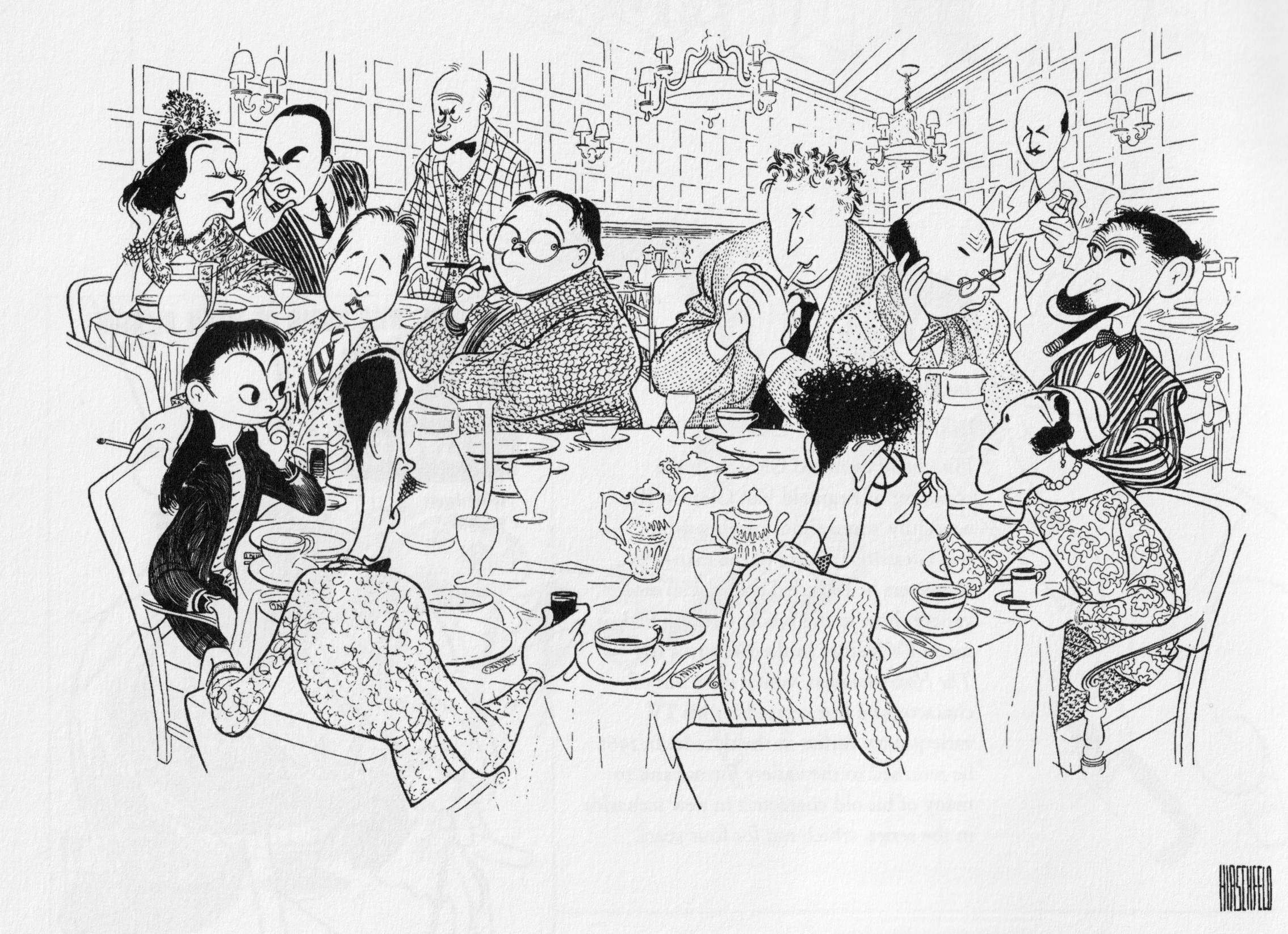
Peter: They want to ask about the Round Table. What was that? Who was in there? What stories do you know about what went on with them? How eccentric was some of them, and so forth.
Question: How has it been working with the cat?
Peter: It’s been okay.
Kevin: It’s been okay. I mean, we work with more cats around. This is my fourth cat and this one is the friendliest out of all of ’em. The first cat, mixed reviews about it. Because that cat just always wandered outside. That cat would wander up to Sixth Avenue and sit on the corner and come back. Wow.
Peter: The first Matilda, right? Yeah. Yeah. She was a diva. Oh yeah. Oh yeah. I was here when we had Hamlet before that Matilda, I’ve been through five cats and that cat, there was actually a book written about him and with drawings by Hilary Knight. I have that book at home. It wasn’t autographed or anything, but it’s been written and I’m glad I have it.
Question: What’s something that kept you coming into work?
Peter: Something? My comrades. The camaraderie that we have here made for a good day every day. The front desk manager, it didn’t matter, the wait staff, but mostly our core group made for great days. It was always a pleasure to come to work, even if people called out, whatever. We found ways to make it work to the satisfaction of the management staff so they knew they could rely on upon us. And you don’t see that. I don’t think you could see that going forward as much as the times we had. Those were really good, great times. What more can I say about that? But it’s been incredible.
Question: What’s a tip you would give to someone reading this about New York City that nobody else knows?
Peter: Well. I say read your book. Read your book. Because that was a mountain of information. There are things in there that I never knew, and you’re quite the researcher and I’m glad I met you.
Question: Oh, thank you.
Peter: It’s been incredible, an incredible relationship. And even though I’m away, I look forward to always looking on the hotel and hopefully if you are around, stay in touch.
Question: What are you going to do in your retirement?
Peter: Well, my plan is to move to Puerto Rico. I have a home over there that was my parent’s. Now I inherited it and I’m going to make a life out of here. They say if you can make it here in New York, you can make it anywhere.
Question: So, from 44th Street to…
Peter: …Isabela, Puerto Rico.
Question: What’s a tip that you always give to people that are asking you about something?
Peter: Send them to the Blue Bar, which is really nice. We always try to promote the restaurant and the bar.
Question: I want to ask you, what’s the hotel like today from when you started your first day?
Peter: I would have to say, well, when I started here, all of these rooms down here were always full. The lobby, what was known as the Rose Room, the Chinese Room, and the Oak Room were always full. I know, because I was the dishwasher and we got all three outlets just dump everything on us every day.
It never stopped from the moment you started to closing time, normally at 12 Midnight, set up a buffet. It was just amazing and busy. This is when Ben and Mary Bodne had the place and they kept it up until they sold it. Then I think slowly, they started cutting back and they took the Blue Bar that was here and they put it over there, which was a good idea. But now the new owners, they have the Blue Bar here now, which is nice, but it’s different. It’s just way different. Their hours of operation are different. They’ve cut back everywhere. I guess it was needed. It’s just a different role now. But that’s fine. So that said, I think it’s a good time for me to fold it in and just say goodbye and wish everyone well and that includes you.
Question: Thank you so much, Peter and Kevin. We will all miss you.
Peter: Thank you.
Kevin: Thank you.
Read more about the history of the Algonquin Hotel in the only book about it, The Algonquin Round Table New York: A Historical Guide (Lyons Press).