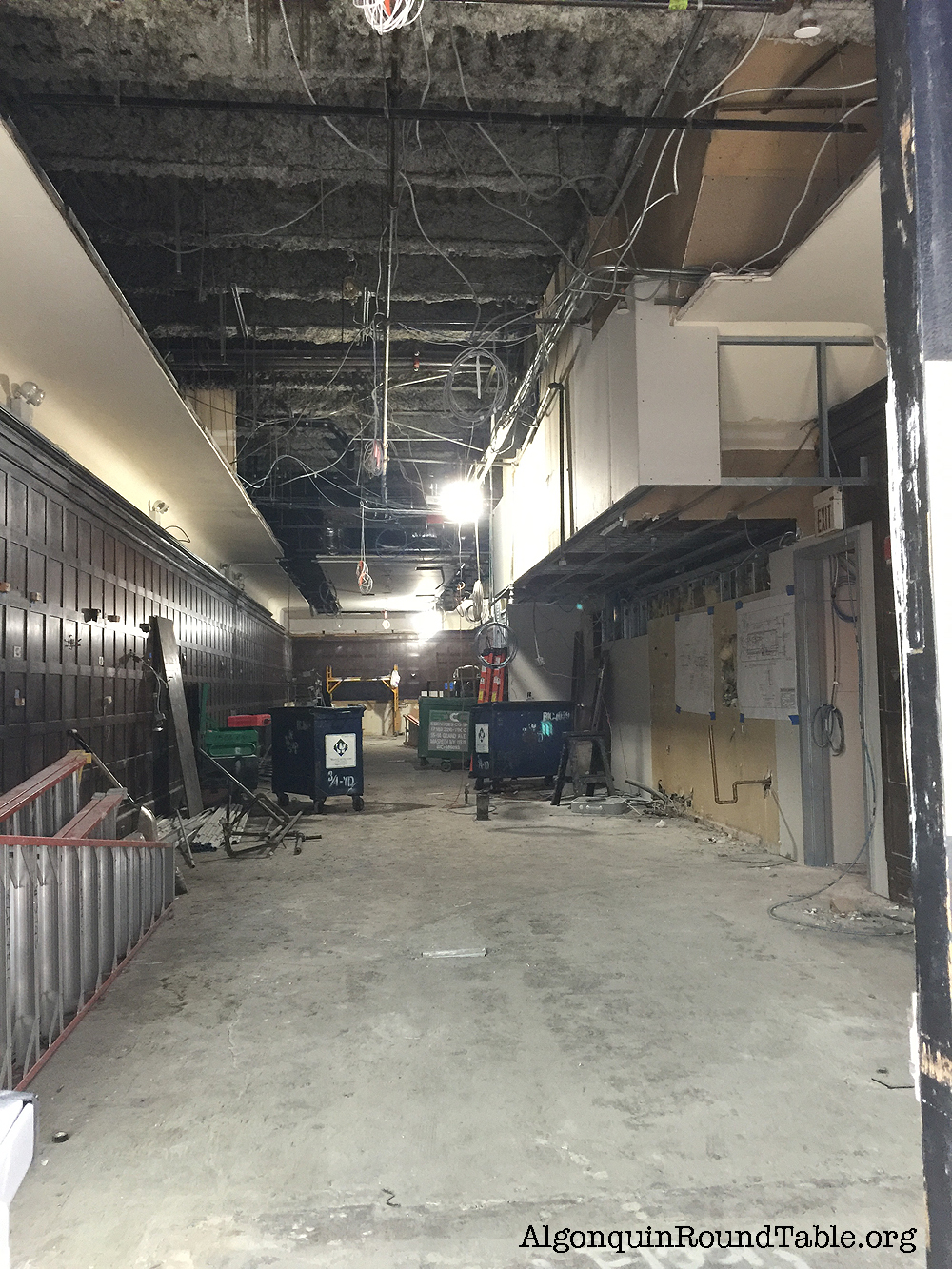
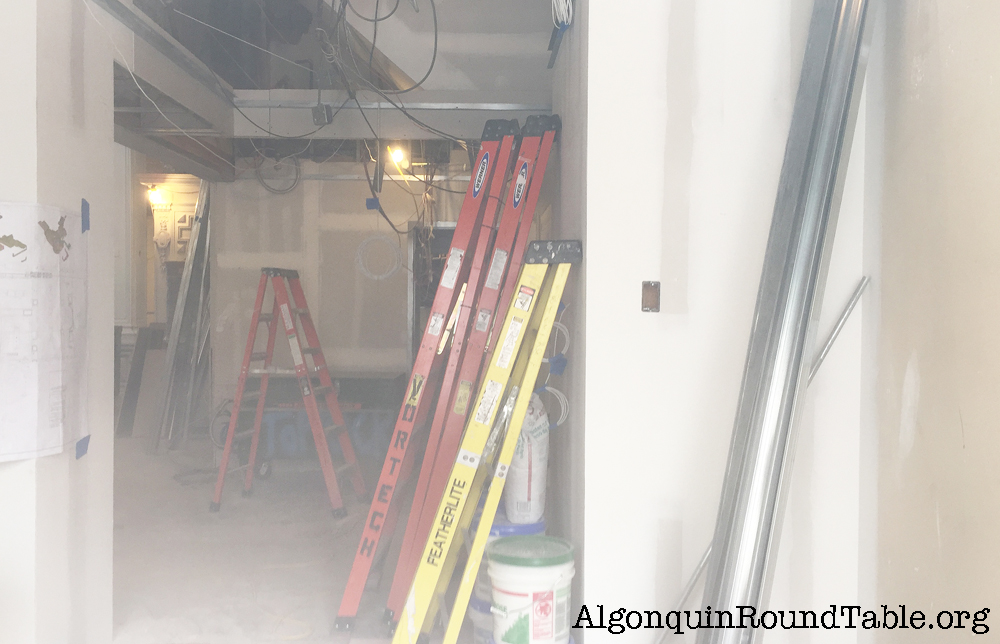
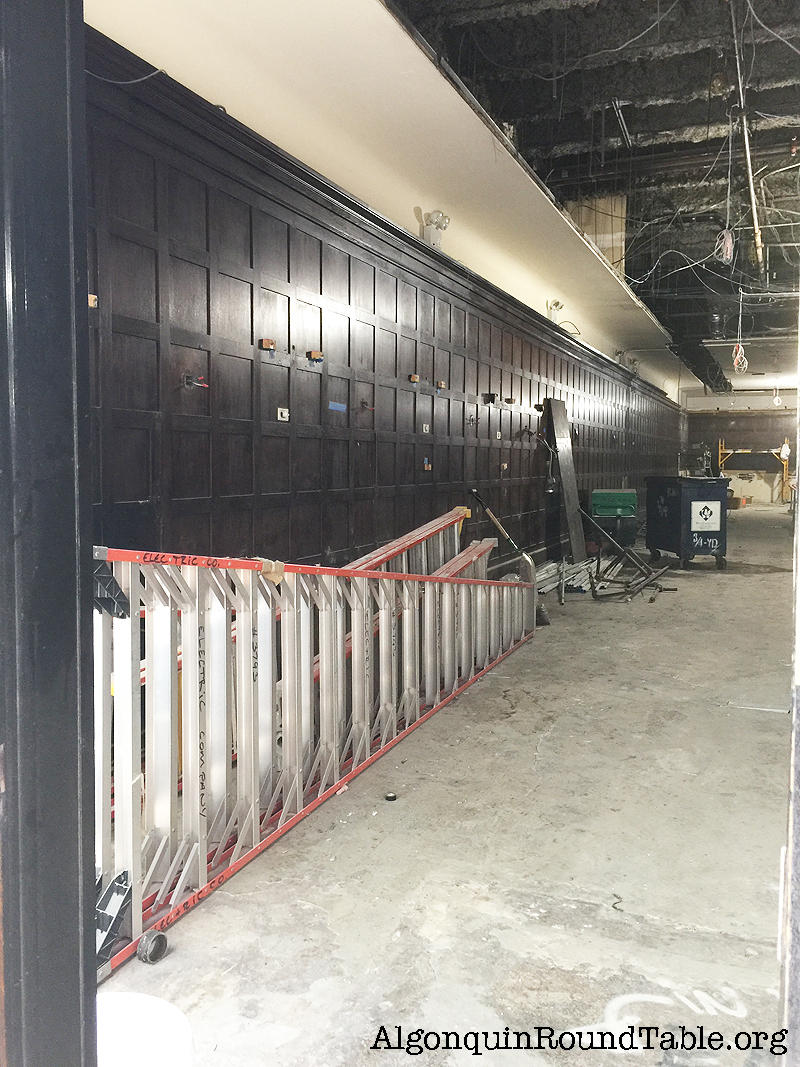
In the most extensive renovation in many decades, the Algonquin Hotel is underway with a major overhaul that has removed the bar, restaurant, front desk, and ceiling. The Round Table is gone, and so is the perch that Hamlet had in the window on Forty-fourth Street.
East side of hotel, where front desk was located.
The hotel, opened in 1902, has removed the Blue Bar completely. Visible from the sidewalk, the ceilings are open and the floors are down to bare concrete. On the east side of the building, the front desk and the areas around it are wide open. The Round Table Room, at the back of the property, is under wraps. Little is visible from the street of the details.
It is currently not open to the public; the owners are using the pandemic to overhaul the property. In April the Algonquin was housing healthcare professionals.
The Algonquin was last renovated in 2012, in an overhaul that saw the Blue Bar expanded and the Oak Room reduced in size. That work maintained the distinctive qualities that dated to the 1998 renovation overseen by Alexandra Champalimaud. That had followed the $20 million mechanical renovation in 1991 ($38 million today) by the Aoki Corporation; that was when the tiny Blue Bar moved across the lobby.
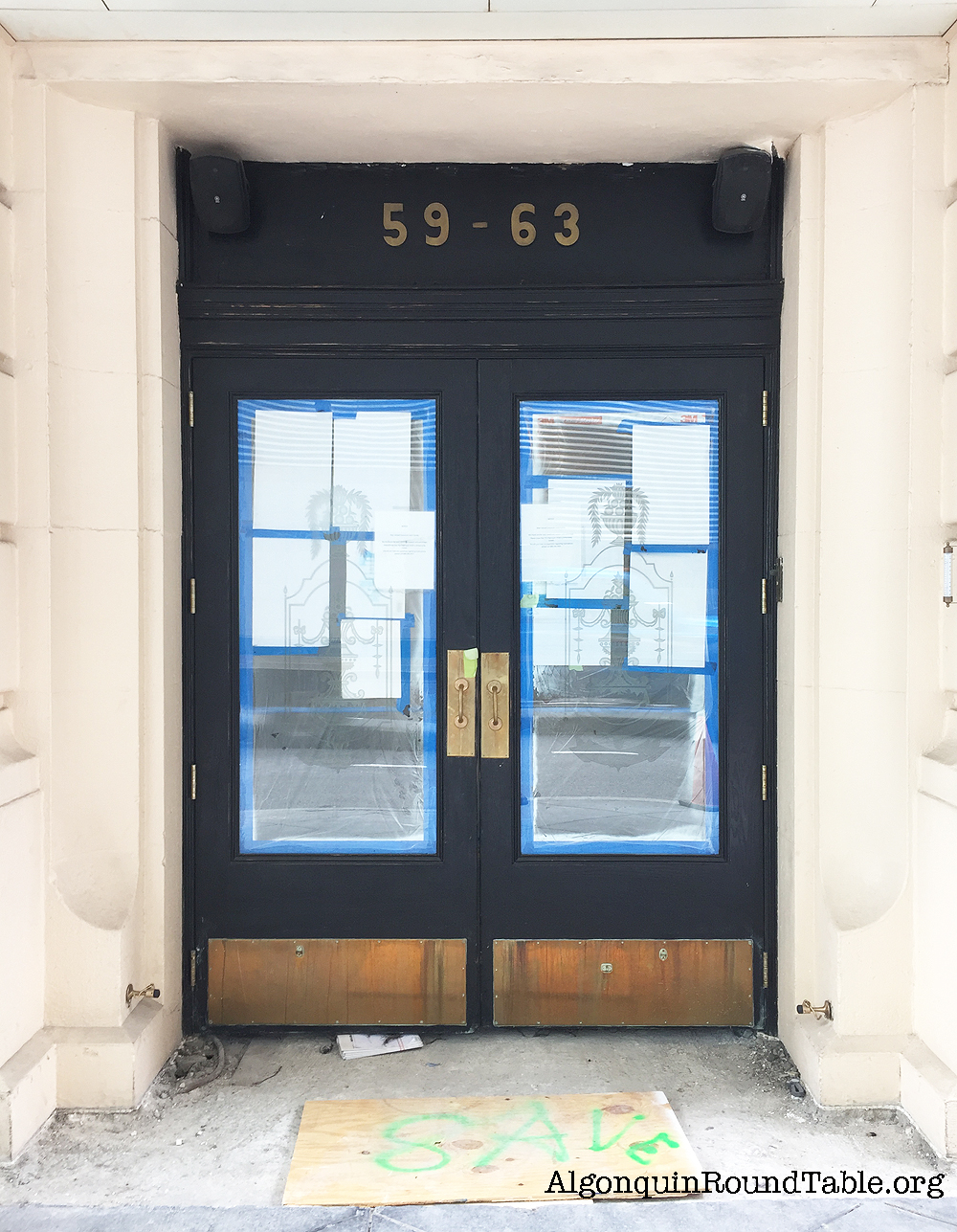
Front entrance, closed to public.
While the Algonquin Hotel has city landmark status, it only applies to the exterior, not to the interior.
I have reached out to Marriott to inquire about a visit and look at the plans. An update could be coming soon.
These photos were taken on August 21, 2020. For the history of the Algonquin Hotel, buy the book.
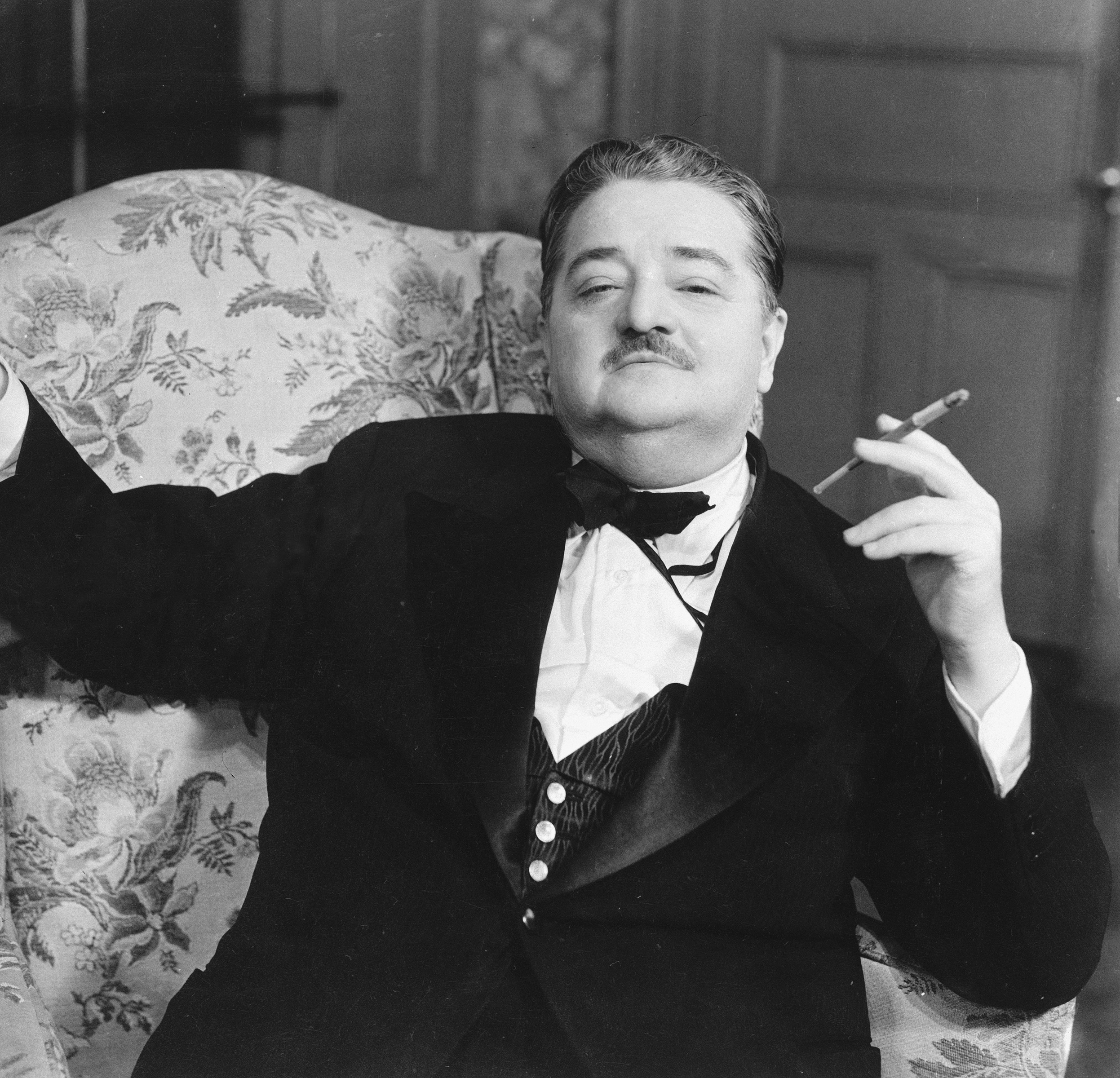
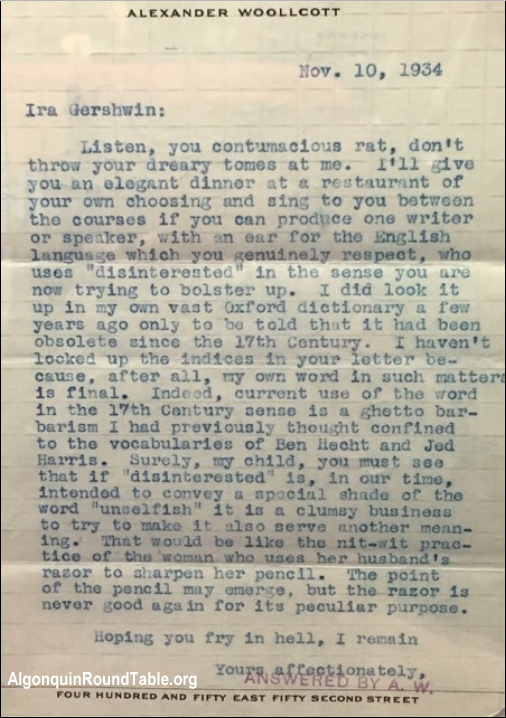
One of the greatest keepers of correspondence of the Algonquin Round Table was the man who the group formed around, Alexander Woollcott. Of all 30 members of the Vicious Circle, only he had his letters posthumously published. One of his greatest hits, from November 10, 1934, turns 85 years old today.
It was written to lyricist and friend Ira Gershwin, among the biggest names in Broadway from the last century. Woollcott was close to him and his brother, George Gershwin. For whatever reason–lost to history today–Ira decided to use the word “disinterested” in the presence of the public and Woollcott. The electric chair that Woollcott wanted to put the Broadway star onto just leaps off the page. Among the others in the letter are Ben Hecht, the newspaperman-turned-playwright who co-wrote The Front Page with Woollcott’s pal, Charles MacArthur, and producer Jed Harris.
The letter in all its glory is presented here.
At the time Woollcott was a radio star on CBS, writing for The New Yorker, and spending months at his vacation home in Vermont on Lake Bomoseen.
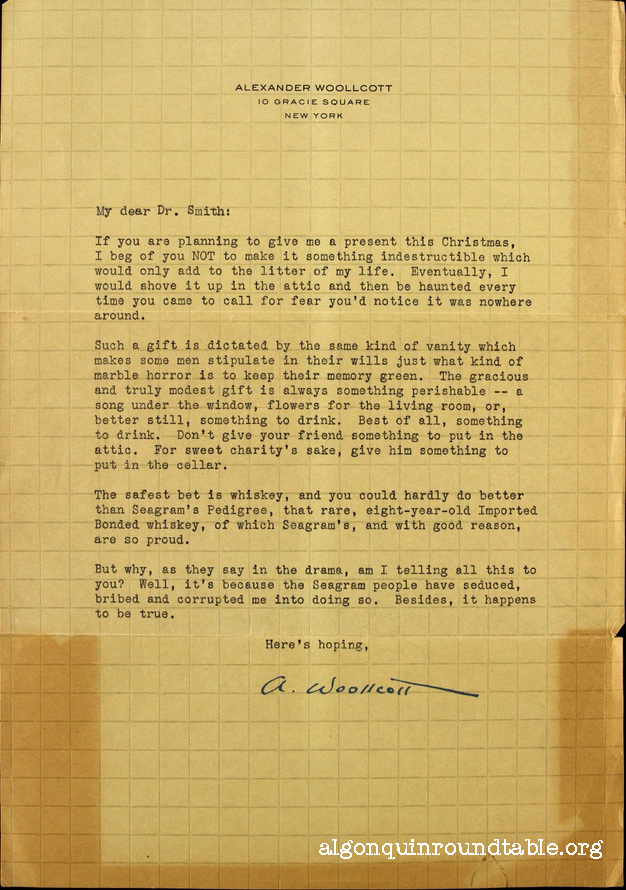
There are many, many other Woollcott letters out there. One of these is a form letter he sent on behalf of a liquor company. It was an early form of product placement, disguised as a letter. The letter is written about from time to time by spirits and Americana writers.
Do YOU own any letters written by members of the Algonquin Round Table? That are not forgeries? Contact me and I’ll gladly look them over.
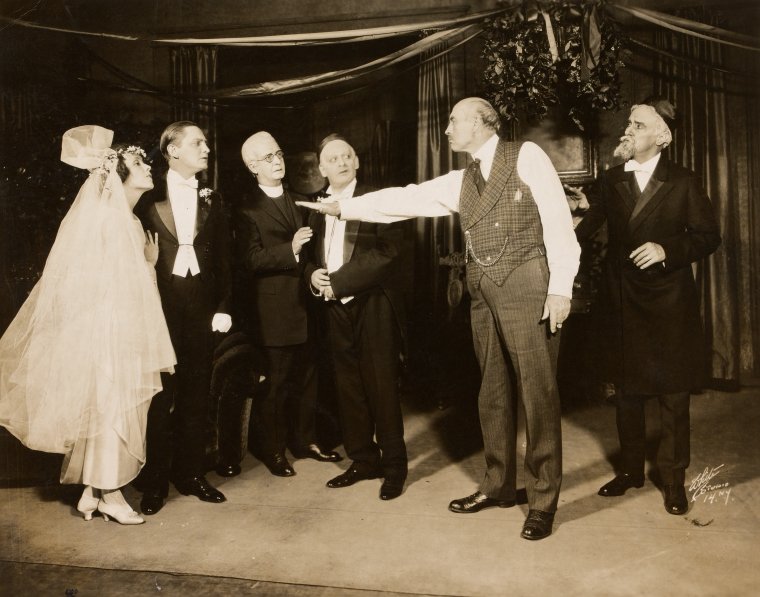
Marie Carroll, Robert Williams, Harry Bradley, Alfred White, John Cope and Howard Lang in scene from Abie’s Irish Rose. Credit: Billy Rose Theatre Division, The New York Public Library.
Today the New York Times published a very thorough and detailed account of the centennial of Abie’s Irish Rose, a hit show 100 years ago that the Algonquin Round Table by turns roasted and scorned. The article quotes Robert Benchley and Alexander Woollcott, with a passing reference to another Vicious Circle member, Harpo Marx.
Opening a few days after St. Patrick’s Day 1922, Abie’s Irish Rose was the miracle show of the decade. Despite withering reviews and serving as the butt of jokes all over town, it ran for 2,327 performances—five years and five months. Anne Nichols wrote the unpretentious comedy allegedly based on a real-life story of a mixed-marriage she heard about. In her story, young Abraham Levy brings home from the war his blushing bride, Rosemary Murphy, a girl he met in France while she was entertaining the doughboys. But knowing how his family would take the news, he introduced her to his parents as Rosie Murpheyski. In the next act the Murphy clan comes over for a visit, and hilarity ensues.
The show appealed to audiences everywhere; at one time six road companies were touring the United States and others were in England and Australia. The playwright raked in more than $6 million and eventually had to cut down on the road companies because the income taxes were crushing her. All the major critics blasted the show, with the exception of Alexander Woollcott. One standout, and long-suffering, reviewer was Robert Benchley. He had to compose a few lines each week for a capsule review in Life. Among his finest gems were, “People laugh at this every night, which explains why democracy can never be a success,” and “Where do the people come from who keep this one going? You don’t see them on the streets in the daytime.”
Dorothy Parker, who is not included in the article, was working for Ainslee’s at the time. She lumped it in with another play of a similar type. In September 1922, she wrote, “And then there came, in quick succession, The Rotters and Abie’s Irish Rose. Despite its having one night’s start on its opponent, The Rotters was defeated by Abie’s Irish Rose for the distinction of being the season’s worst play.”
As the Times points out, no modern theater company is currently interested in a revival of Abie’s Irish Rose. Which may be a good thing.
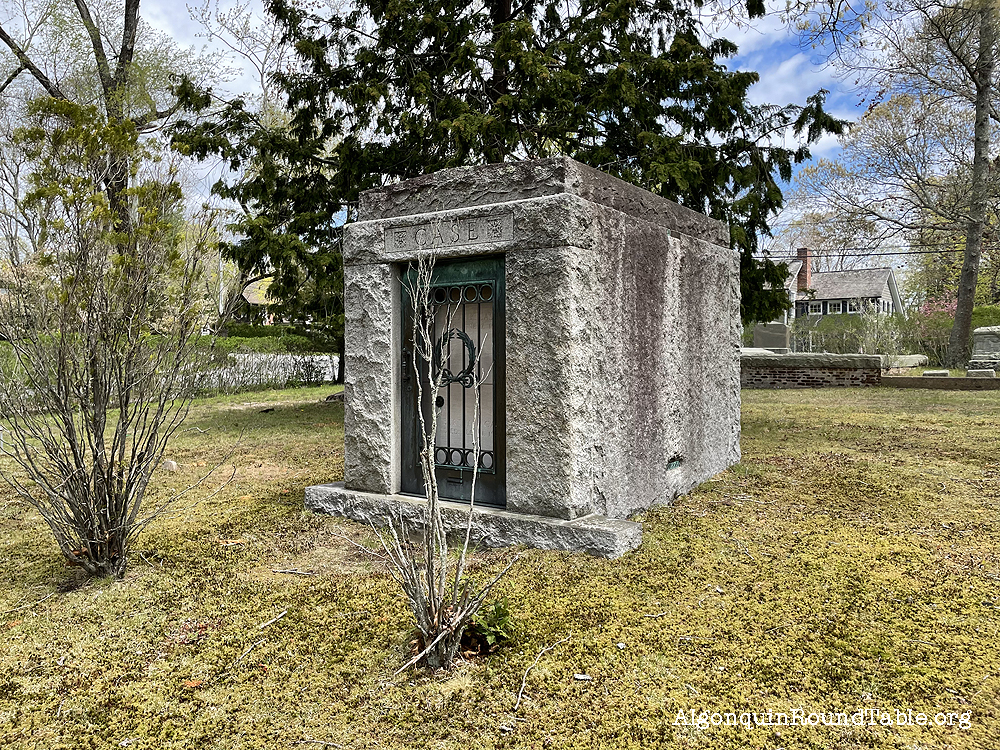
I found Frank Case. I wasn’t even looking for him. I was in Oakland Cemetery in Sag Harbor, Long Island, for the first time. I was actually looking for a Doughboy for our WWI Homecoming 21 project. As I was walking along the line of graves, since I didn’t know the location, I was peering at each one as quickly as possible. At the corner of the cemetery, in the corner of my eye, was a lone mausoleum. There are not that many in Oakland, just a few, it is not Woodlawn. As I stepped closer I saw the name across the top: CASE.
I was so happy to see this. Here was the general manager and owner of the Algonquin Hotel.
I had known for many years that Case (1871-1946) had a second home in Sag Harbor. He wrote about the home in his books, as did his only daughter, Margaret Case Harriman. While Case was the most famous hotelier in America at one time, I never knew where he ended up after his death in Manhattan. I assumed, wrongly, that he had gone home to Buffalo, New York, his hometown, and where his first wife, Carrie Case, was buried in 1908 after she tragically died in the Algonquin Hotel following the birth of their son, Carrol.
Frank and Bertha Case
One thing I learned a long time ago was to never trust the Internet. When I was researching my book The Algonquin Round Table New York: A Historical Guide (2015) I was on a mission to track down the final resting places of the Vicious Circle. I did locate almost all 30 of them, but there are a few that still escape me (where are you Jane Grant and Robert E. Sherwood?). But I found many inaccuracies and misinformation. I made a pass at looking for Case; one lead was he was buried in Woodlawn, which was wrong. Many obituaries list New Yorker’s would hold their memorials in Woodlawn, then the remains sent away to other towns for burial. What I suspect is after his death, which was just four months after his second wife, Bertha, his family brought Bertha and Frank to the receiving vaults of Woodlawn. Here they remained temporarily while the mausoleum was constructed in Sag Harbor. I guess if I had 10 hours of free time I could check the records of both cemeteries, so perhaps if someone reading this wants to hire me for a paid assignment I will do that.
I like finding this mausoleum and closing the circle on Frank Case, who was by all accounts beloved by friends and staff (but was anti-union). He was also, like me, a member of The Lambs (the clubhouse was 2 minutes away west on Forty-fourth Street, and many of the actors who were members also lived at the hotel, such as John Drew and nephew John Barrymore).
One story told in the obituary of Bertha Case is about Sag Harbor. Bertha was a housekeeper at the Algonquin, which is how she met Frank. During WWI she volunteered and went to France with the YMCA as a volunteer, and was friends with superstar Elsie Janis (also an Algonquin regular). She and Frank were married for 30 years. What Bertha did was use the flower gardens at the Sag Harbor house to provide floral arrangements for the hotel–which she oversaw. Sag Harbor is also where the Case family entertained friends, such as Robert Benchley.
If you are in Sag Harbor and the South Fork of Long Island, pay a visit to Frank and Bertha Case.