Algonquin Round Table History,News Classic Woollcott Letter Turns 85 Years Old

Classic Woollcott Letter Turns 85 Years Old

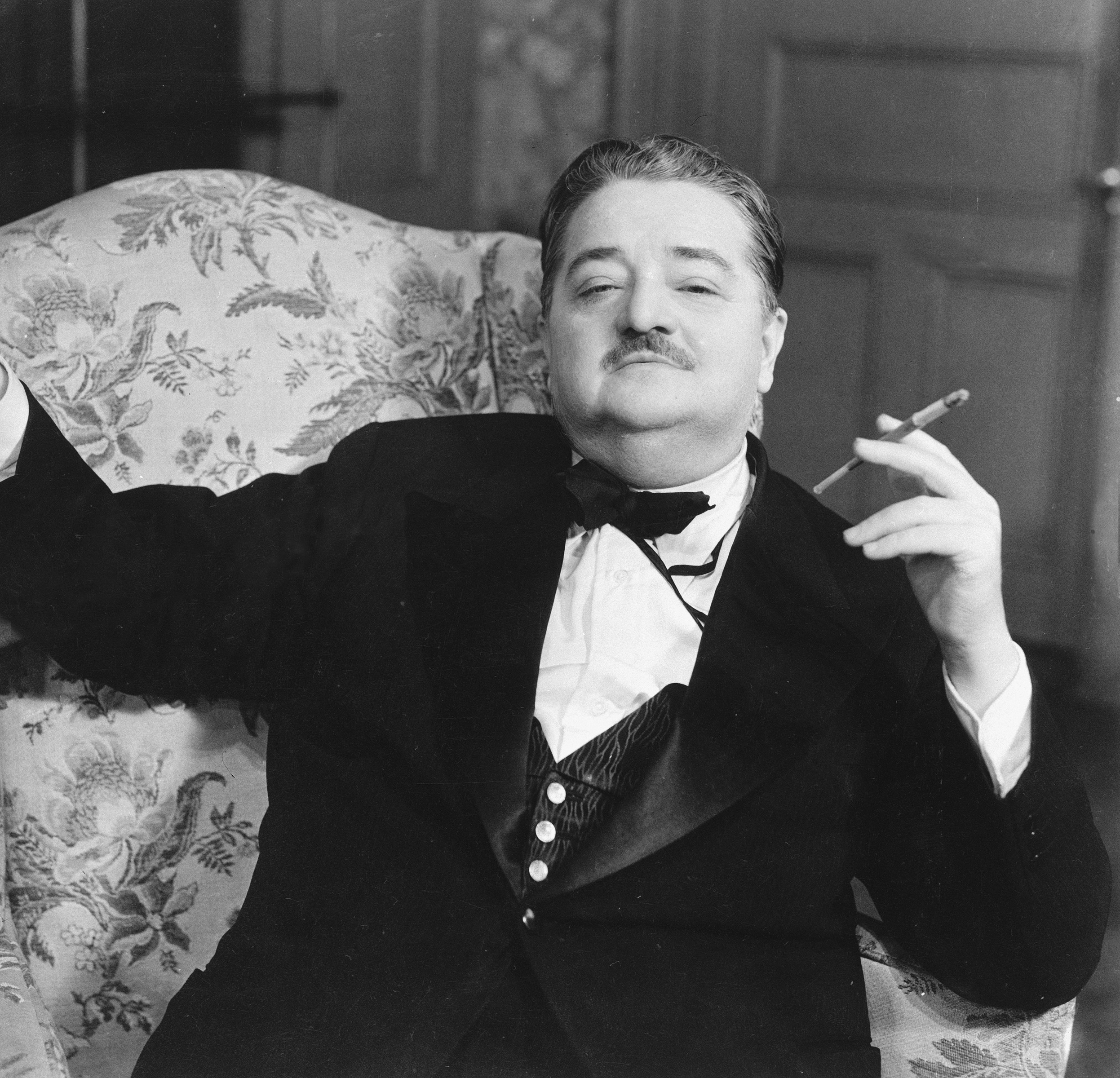
Alexander Woollcott, 1938.

One of the greatest keepers of correspondence of the Algonquin Round Table was the man who the group formed around, Alexander Woollcott. Of all 30 members of the Vicious Circle, only he had his letters posthumously published. One of his greatest hits, from November 10, 1934, turns 85 years old today.

It was written to lyricist and friend Ira Gershwin, among the biggest names in Broadway from the last century. Woollcott was close to him and his brother, George Gershwin. For whatever reason–lost to history today–Ira decided to use the word “disinterested” in the presence of the public and Woollcott. The electric chair that Woollcott wanted to put the Broadway star onto just leaps off the page. Among the others in the letter are Ben Hecht, the newspaperman-turned-playwright who co-wrote The Front Page with Woollcott’s pal, Charles MacArthur, and producer Jed Harris.

The letter in all its glory is presented here.
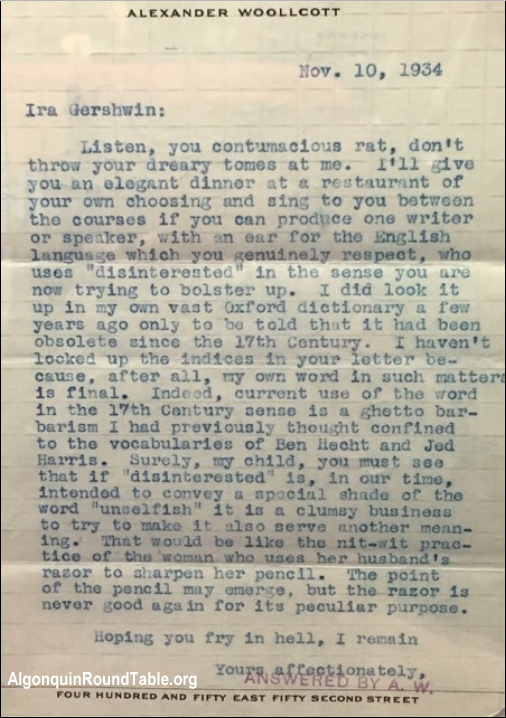
At the time Woollcott was a radio star on CBS, writing for The New Yorker, and spending months at his vacation home in Vermont on Lake Bomoseen.

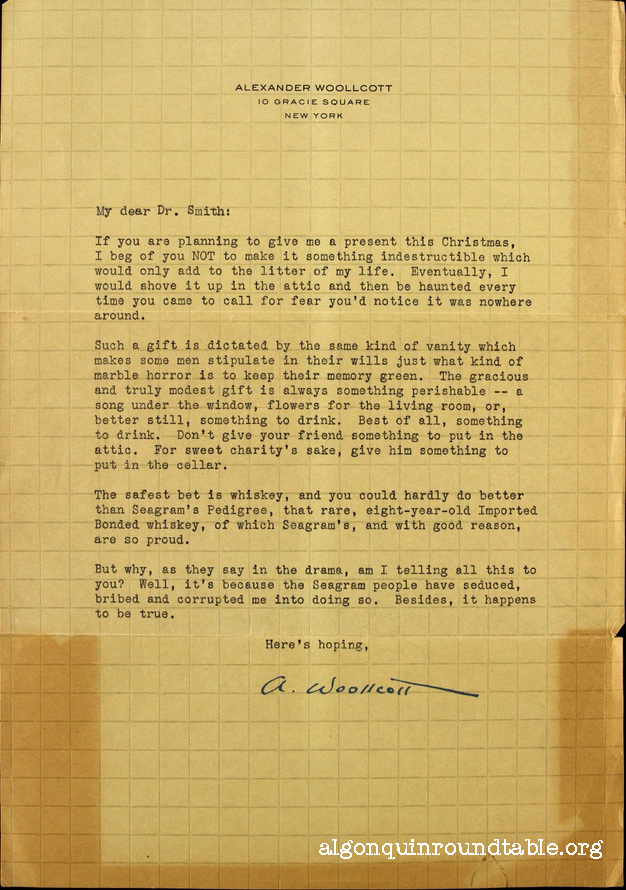
There are many, many other Woollcott letters out there. One of these is a form letter he sent on behalf of a liquor company. It was an early form of product placement, disguised as a letter. The letter is written about from time to time by spirits and Americana writers.
Do YOU own any letters written by members of the Algonquin Round Table? That are not forgeries? Contact me and I’ll gladly look them over.


Related Post

Heywood Broun on Babe Ruth in 1922Heywood Broun on Babe Ruth in 1922

With baseball season around the corner, let’s look at one of the many Algonquin Round Table links to the game. In the world of New York newspaper columnists in the Jazz Age, Heywood Broun stood out from the rest. His column “It Seems To Me” was beloved, and he could tackle any subject. Broun had gotten his start as a baseball writer, and continued his passion for ballpark trips even when he became a celebrity covering Broadway and news stories. Broun had seats in the press box to watch Babe Ruth in his amazing 1921 season with the New York Yankees. This column appeared in 1922.

Ruth Vs. Roth
By Heywood Broun

We picked up “Who’s Who in America” yesterday to get some vital statistics about Babe Ruth, and found to our surprise that he was not in the book. Even as George Herman Ruth there is no mention of him. The nearest name we could find was: “Roth, Filibert, forestry expert; b. Württemberg, Germany, April 20, 1858; s. Paul Raphael and Amalie (Volz) R., early edn. in Württemberg—”

There is in our heart not an atom of malice against Prof. Roth (since September, 1903, he has been “prof. forestry, U. Mich.”), and yet we question the justice of his admission to a list of national celebrities while Ruth stands without. We know, of course, that Prof. Roth is the author of “Forest Conditions in Wisconsin” and of “The Uses of Wood,” but we wonder whether he has been able to describe in words uses of wood more sensational and vital than those which Ruth has shown in deeds. Hereby we challenge the editor of “Who’s Who in America” to debate the affirmative side of the question: Resolved, That Prof. Roth’s volume called “Timber Physics” has exerted a more profound influence in the life of America than Babe Ruth’s 1921 home-run record.

Heywood Broun

Heywood Broun

The question is, of course, merely a continuation of the ancient controversy as to the relative importance of the theorist and the practitioner: should history prefer in honor the man who first developed the hypothesis that the world was round or the other who went out and circumnavigated it? What do we owe to Ben Franklin and what to the lightning? Shall we celebrate Newton or the apple?

Personally, our sympathies go out to the performer rather than the fellow in the study or the laboratory. Many scientists staked their reputations on the fact that the world was round before Magellan set sail on the Vittoria. He did not lack written assurances that there was no truth in the old tale of a flat earth with dragons and monsters lurking just beyond the edges.

But suppose, in spite of all this, Magellan had gone on sailing, sailing until his ship did topple over into the void of dragons and big snakes. The professors would have been abashed. Undoubtedly they would try to laugh the misfortune off, and they might even have been good enough sports to say, “That’s a fine joke on us.” But at worst they could lose nothing but their reputations, which can be made over again. Magellan would not live to profit by his experience. Being one of those foreigners, he had no sense of humor, and if the dragons bit him as he fell, it is ten to one he could not even manage a smile.

By this time we have rather traveled away from Roth’s “Timber Physics” and Ruth’s home-run record, but we hope that you get what we mean. Without knowing the exact nature of “Timber Physics,” we assume that the professor discusses the most efficient manner in which to bring about the greatest possible impact between any wooden substance and a given object. But mind you, he merely discusses it. If the professor chances to be wrong, even if he is wrong three times, nobody in the classroom is likely to shout, “You’re out!”

The professor remains at bat during good behavior. He is not subject to any such vicissitudes as Ruth. Moreover, timber physics is to Mr. Roth a matter of cool and calm deliberation. No adversary seeks to fool him with speed or spitballs. “Hit it out” never rings in his ears. And after all, just what difference does it make if Mr. Roth errs in his timber physics? It merely means that a certain number of students leave Michigan knowing a little less than they should—and nobody expects anything else from students.

On the other hand, a miscalculation by Ruth in the uses of wood affects much more important matters. A strike-out on his part may bring about complete tragedy and the direst misfortune. There have been occasions, and we fear that there will still be occasions, when Ruth’s bat will be the only thing which stands between us and the loss of the American League pennant. In times like these who cares about “Forest Conditions in Wisconsin”?

Coming to the final summing up for our side of the question at debate, we shall try to lift the whole affair above any mere Ruth versus Roth issue. It will be our endeavor to show that not only has Babe Ruth been a profound interest and influence in America, but that on the whole he has been a power for progress. Ruth has helped to make life a little more gallant. He has set before us an example of a man who tries each minute for all or nothing. When he is not knocking home runs he is generally striking out, and isn’t there more glory in fanning in an effort to put the ball over the fence than in prolonging a little life by playing safe?

***

Adapted from The Lost Algonquin Round Table: Humor, Fiction, Journalism, Criticism and Poetry From America’s Most Famous Literary Circle (Donald Books/iUniverse). Edited by Nat Benchley and Kevin C. Fitzpatrick. Available Here.

Marie Carroll, Robert Williams, Harry Bradley, Alfred White, John Cope and Howard Lang in scene from Abie's Irish Rose. Credit: Billy Rose Theatre Division, The New York Public Library.

Centennial of Abie’s Irish RoseCentennial of Abie’s Irish Rose

Marie Carroll, Robert Williams, Harry Bradley, Alfred White, John Cope and Howard Lang in scene from Abie's Irish Rose. Credit: Billy Rose Theatre Division, The New York Public Library.

Marie Carroll, Robert Williams, Harry Bradley, Alfred White, John Cope and Howard Lang in scene from Abie’s Irish Rose. Credit: Billy Rose Theatre Division, The New York Public Library.


Today the New York Times published a very thorough and detailed account of the centennial of Abie’s Irish Rose, a hit show 100 years ago that the Algonquin Round Table by turns roasted and scorned. The article quotes Robert Benchley and Alexander Woollcott, with a passing reference to another Vicious Circle member, Harpo Marx.

Opening a few days after St. Patrick’s Day 1922, Abie’s Irish Rose was the miracle show of the decade. Despite withering reviews and serving as the butt of jokes all over town, it ran for 2,327 performances—five years and five months. Anne Nichols wrote the unpretentious comedy allegedly based on a real-life story of a mixed-marriage she heard about. In her story, young Abraham Levy brings home from the war his blushing bride, Rosemary Murphy, a girl he met in France while she was entertaining the doughboys. But knowing how his family would take the news, he introduced her to his parents as Rosie Murpheyski. In the next act the Murphy clan comes over for a visit, and hilarity ensues.

The show appealed to audiences everywhere; at one time six road companies were touring the United States and others were in England and Australia. The playwright raked in more than $6 million and eventually had to cut down on the road companies because the income taxes were crushing her. All the major critics blasted the show, with the exception of Alexander Woollcott. One standout, and long-suffering, reviewer was Robert Benchley. He had to compose a few lines each week for a capsule review in Life. Among his finest gems were, “People laugh at this every night, which explains why democracy can never be a success,” and “Where do the people come from who keep this one going? You don’t see them on the streets in the daytime.”

Dorothy Parker, who is not included in the article, was working for Ainslee’s at the time. She lumped it in with another play of a similar type. In September 1922, she wrote, “And then there came, in quick succession, The Rotters and Abie’s Irish Rose. Despite its having one night’s start on its opponent, The Rotters was defeated by Abie’s Irish Rose for the distinction of being the season’s worst play.”

As the Times points out, no modern theater company is currently interested in a revival of Abie’s Irish Rose. Which may be a good thing.

The Dorothy Parker reviews from the era are collected in Dorothy Parker Complete Broadway, 1918-1923.

Divided By Three

The Flop of 1934, Divided By Three Fails to Find an AudienceThe Flop of 1934, Divided By Three Fails to Find an Audience

Eighty-five years ago the Algonquin Round Table members Peggy Leech and Bea Kaufman were licking their wounds after their debut collaboration flopped on Broadway. The two friends worked for about a year on a drama that failed to succeed. Divided by Three was the first play to open the Ethel Barrymore Theatre. It had a popular cast, led by megastar Judith Anderson, with a young Jimmy Stewart in a supporting role.

Divided By Three has not been published and is not available. It ran for just 32 performances in October 1934. Among the tepid reviews were this one from Time, 10/15/1934:

Divided by Three (by Margaret Leech Pulitzer and Beatrice Kaufman; Guthrie McClintic, producer) was written to make room for the superb abilities of smoldering Judith Anderson. It borrows the plot of Eugene O’Neill’s Strange Interlude and puts Miss Anderson back in the role she enormously enjoyed for a year. In Divided by Three again she is divided by: 1) her aggressive middle-aged lover (James Rennie); 2) her incredibly unsuspecting putterer of a husband; 3) her son (James Stewart). She finds it desirable and, until the second act curtain, possible to accept all three simultaneously.

It is her son who learns of her adultery, through the kindly offices of his priggish fiancée. As priggish as she, he calls his mother a whore and withdraws his love from both mother and fiancée. The last act allows everyone (still except the husband) to become readjusted to the situation. The son still feels that adultery is wrong; his mother is still determined to have what she wants. But just as she decides to come clean and divorce her husband, he comes home with the news that he has been wiped out in the stock market. Like the noble character she is, she drops the divorce plans. Her lover, after a minute’s anguish, decides after all to stay for dinner.

Only Judith Anderson makes this implausible story a moving and challenging affair. She bats her heavy-lidded eyes, settles her welterweight shoulders and makes her audience feel that something important is happening. Noteworthy are Donald Oenslager’s handsome settings.

Divided By Three

Judith Anderson rehearsing with director Guthrie McClintic for “Divided by Three” in his garden. ©The New York Public Library.


More newsworthy than their first play are Divided by Three’s authors.

Margaret Leech Pulitzer is the second wife of that studious, shy Ralph Pulitzer whom newspapermen have never forgiven for letting his late great father’s New York World be sold, and whom they howled out of accepting the post of administrator of the NRA newspaper code.

Beatrice Bakrow Kaufman is the wife of playwright George S. Kaufman (Of Thee I Sing, Once in a Lifetime, Dinner at Eight, Merrily We Roll Along), who lives on meat and chocolate peppermints, talks to himself on the street and is on the administration committee of the NRA theatre code.

Both Mrs. Pulitzer and Mrs. Kaufman are ringleaders of Manhattan’s first-nighting, croquet-playing, waggish literary-theatrical-social set. Mrs. Pulitzer has a two-year-old daughter; Mrs. Kaufman has a nine-year-old daughter. Mrs. Pulitzer graduated from Vassar, has written three competent novels, hates bridge, likes travel. Mrs. Kaufman quit Wellesley after a year; quit the University of Rochester to marry Mr. Kaufman. She is convinced she is No. 1 woman croquet player of the U. S.

Last week Manhattan critics tried to like their friends’ first play but only half of them succeeded.