Algonquin Round Table History Crazy for Games, Sports, and Puzzles

Crazy for Games, Sports, and Puzzles

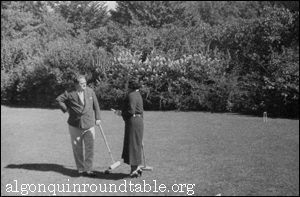
Woollcott and Ferber

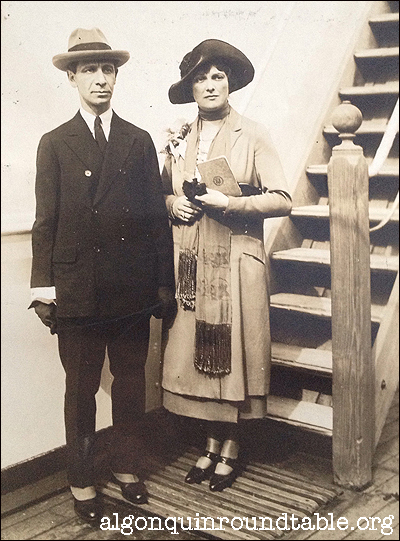
Alexander Woollcott and Edna Ferber, at the home of Margaret Leech and Ralph Pulitzer (Photo courtesy of Kate Pulitzer Freedberg)


Sports and leisure were important to the Round Table. They loved professional sports—with baseball and boxing being the chief attractions. F.P.A. was an amateur tennis star. Their leisure time was taken up with parlor games, mind-benders, word play, and gambling. Their poker games were soul-crushing feats of gambling (Broun won and lost his house at a poker table). Charades and croquet consumed them.

Neysa McMein was credited with “inventing”—or at least popularizing—Scavenger Hunts. F.P.A. wrote about it in “The Conning Tower” on July 28, 1925:

“To Jane Grant’s, where was a party for Alice Miller’s birthday, and had a merry time of it, save for a silly treasure hunt, a craze that hath become widespread while I was not here to crusade against it.”

While playing I Can Give You A Sentence, Dorothy Parker was tasked to use “horticulture” which led to the oft quoted, “You can lead a horticulture, but you can’t make her think.” Baseball was a passion, especially New York Giants games at the Polo Grounds. F.P.A. wrote “Baseball’s Sad Lexicon” one of the most famous baseball poems of all time following a Giants game. Broun is in the Baseball Hall of Fame’s sportswriters wing in Cooperstown.

The friends were crazy for crossword puzzles; they even wrote a book of them together. On January 4, 1925, the first Intercollegiate Cross Word Puzzle Tournament was held in the auditorium of the Hotel Roosevelt, 45 East 45th Street. With hundreds of cheering fans in the audience, Yale edged out Harvard, Princeton and the City College of New York. On the Harvard team were Broun (who never really graduated) and Robert E. Sherwood. Poet Stephen Vincent Benet and Jack Thomas made up the Yale team. The contest was held in rounds and each word was tackled individually. First Broun won a round by correctly guessing the name of a German poet with five letters (Heine). Then Sherwood backed him up with a seven-letter word meaning “honest in intention” (sincere). However, a foul play was called when the judge, Ruth Hale, sat beside her spouse, Broun.
Related Post

Robert Benchley

Listen to The Secret Life of Walter MittyListen to The Secret Life of Walter Mitty

Today is the 74th anniversary of recording The Secret Life of Walter Mitty (1944).

“The Secret Life of Walter Mitty” with Robert Benchley. Recorded for CBS on Dec. 20, 1944. Based on the 1939 short story by James Thurber, this is the full radio dramatization. It comes from “This Is My Best” radio series. Thurber praised Benchley’s performance, and didn’t like the 1947 Danny Kaye musical comedy version. Mogul David Selznick approached Benchley in 1940 about making a short film based on the Mitty story that first appeared in The New Yorker, but it didn’t work out. Less than a year after this recording was made, Benchley died in New York. “The Secret Life of Walter Mitty” is included in “Thurber Writings and Drawings” (Library of America series).

From The Algonquin Round Table New York: A Historical Guide (Lyons Press, 2015), by Kevin C. Fitzpatrick, with a foreword by Anthony Melchiorri.

Marie Carroll, Robert Williams, Harry Bradley, Alfred White, John Cope and Howard Lang in scene from Abie's Irish Rose. Credit: Billy Rose Theatre Division, The New York Public Library.

Centennial of Abie’s Irish RoseCentennial of Abie’s Irish Rose

Marie Carroll, Robert Williams, Harry Bradley, Alfred White, John Cope and Howard Lang in scene from Abie's Irish Rose. Credit: Billy Rose Theatre Division, The New York Public Library.

Marie Carroll, Robert Williams, Harry Bradley, Alfred White, John Cope and Howard Lang in scene from Abie’s Irish Rose. Credit: Billy Rose Theatre Division, The New York Public Library.


Today the New York Times published a very thorough and detailed account of the centennial of Abie’s Irish Rose, a hit show 100 years ago that the Algonquin Round Table by turns roasted and scorned. The article quotes Robert Benchley and Alexander Woollcott, with a passing reference to another Vicious Circle member, Harpo Marx.

Opening a few days after St. Patrick’s Day 1922, Abie’s Irish Rose was the miracle show of the decade. Despite withering reviews and serving as the butt of jokes all over town, it ran for 2,327 performances—five years and five months. Anne Nichols wrote the unpretentious comedy allegedly based on a real-life story of a mixed-marriage she heard about. In her story, young Abraham Levy brings home from the war his blushing bride, Rosemary Murphy, a girl he met in France while she was entertaining the doughboys. But knowing how his family would take the news, he introduced her to his parents as Rosie Murpheyski. In the next act the Murphy clan comes over for a visit, and hilarity ensues.

The show appealed to audiences everywhere; at one time six road companies were touring the United States and others were in England and Australia. The playwright raked in more than $6 million and eventually had to cut down on the road companies because the income taxes were crushing her. All the major critics blasted the show, with the exception of Alexander Woollcott. One standout, and long-suffering, reviewer was Robert Benchley. He had to compose a few lines each week for a capsule review in Life. Among his finest gems were, “People laugh at this every night, which explains why democracy can never be a success,” and “Where do the people come from who keep this one going? You don’t see them on the streets in the daytime.”

Dorothy Parker, who is not included in the article, was working for Ainslee’s at the time. She lumped it in with another play of a similar type. In September 1922, she wrote, “And then there came, in quick succession, The Rotters and Abie’s Irish Rose. Despite its having one night’s start on its opponent, The Rotters was defeated by Abie’s Irish Rose for the distinction of being the season’s worst play.”

As the Times points out, no modern theater company is currently interested in a revival of Abie’s Irish Rose. Which may be a good thing.

The Dorothy Parker reviews from the era are collected in Dorothy Parker Complete Broadway, 1918-1923.

Heywood Broun

Heywood Broun on Actors and VaudevilleHeywood Broun on Actors and Vaudeville

Heywood Broun

Heywood Broun


On this day in 1938 Heywood Broun died. Here is a sample of one of his columns. From “It Seems To Me.” He loved vaudeville and the stage.

On Actors

Nothing in the world dies quite as completely as an actor and the greater the actor the more terrifying becomes the sudden transition from radiance to darkness. One day he is there with all his moods and complexities and curious glints of this and that, and the next day there is nothing left but a few wigs and costumes; perhaps a volume of memoirs, and a scrapbook of clippings in which we learn that the dead player was “majestic in presence” that “the poise of his head was stag-like” that he had “a great voice which boomed like a bell,” that he was “regal, subtle, pathetic,” and that “every one who was ever associated with him loved and respected him.”

Ask some veteran theatergoer “What was Booth like as Hamlet?” and he will say “Oh, he was wonderful.” Perhaps the face of the old theatergoer will grow animated and Booth may live again for a moment in his mind, but we who have never seen Booth will never know anything about him. Nobody can recreate and explain the art of a dead actor to the next generation. Even men who do tricks and true magic with words are not adept enough to set down any lasting portrait of an actor on the wing.