Video interview on WRNN TV in New York. Andrew Whiteman interviews Kevin C. Fitzpatrick on the history of the Vicious Circle. Filmed at the Algonquin Hotel.
Related Post
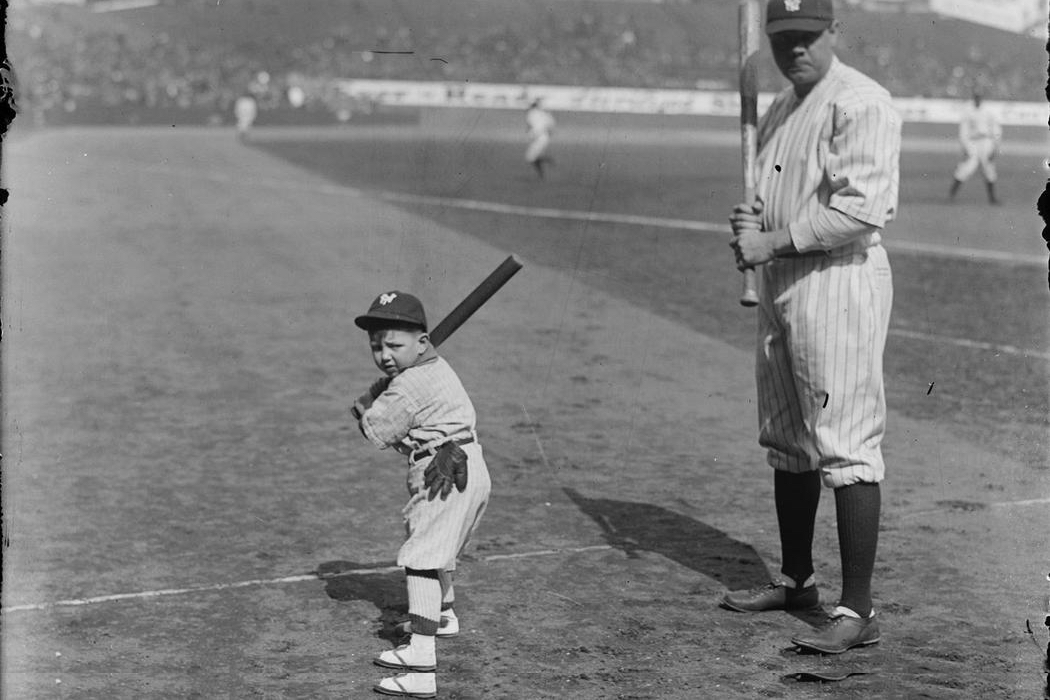
Heywood Broun on Babe Ruth in 1922Heywood Broun on Babe Ruth in 1922
With baseball season around the corner, let’s look at one of the many Algonquin Round Table links to the game. In the world of New York newspaper columnists in the Jazz Age, Heywood Broun stood out from the rest. His column “It Seems To Me” was beloved, and he could tackle any subject. Broun had gotten his start as a baseball writer, and continued his passion for ballpark trips even when he became a celebrity covering Broadway and news stories. Broun had seats in the press box to watch Babe Ruth in his amazing 1921 season with the New York Yankees. This column appeared in 1922.
Ruth Vs. Roth
By Heywood Broun
We picked up “Who’s Who in America” yesterday to get some vital statistics about Babe Ruth, and found to our surprise that he was not in the book. Even as George Herman Ruth there is no mention of him. The nearest name we could find was: “Roth, Filibert, forestry expert; b. Württemberg, Germany, April 20, 1858; s. Paul Raphael and Amalie (Volz) R., early edn. in Württemberg—”
There is in our heart not an atom of malice against Prof. Roth (since September, 1903, he has been “prof. forestry, U. Mich.”), and yet we question the justice of his admission to a list of national celebrities while Ruth stands without. We know, of course, that Prof. Roth is the author of “Forest Conditions in Wisconsin” and of “The Uses of Wood,” but we wonder whether he has been able to describe in words uses of wood more sensational and vital than those which Ruth has shown in deeds. Hereby we challenge the editor of “Who’s Who in America” to debate the affirmative side of the question: Resolved, That Prof. Roth’s volume called “Timber Physics” has exerted a more profound influence in the life of America than Babe Ruth’s 1921 home-run record.
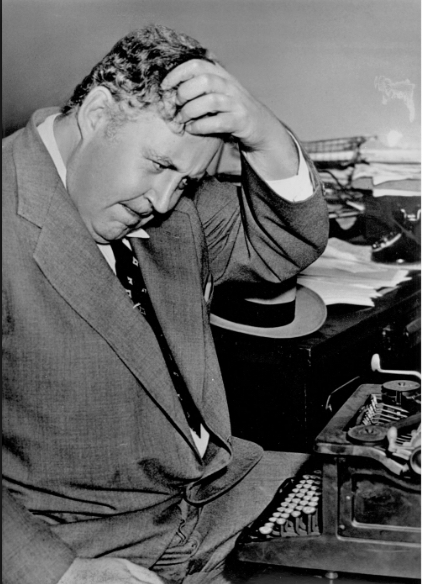
Heywood Broun
Personally, our sympathies go out to the performer rather than the fellow in the study or the laboratory. Many scientists staked their reputations on the fact that the world was round before Magellan set sail on the Vittoria. He did not lack written assurances that there was no truth in the old tale of a flat earth with dragons and monsters lurking just beyond the edges.
But suppose, in spite of all this, Magellan had gone on sailing, sailing until his ship did topple over into the void of dragons and big snakes. The professors would have been abashed. Undoubtedly they would try to laugh the misfortune off, and they might even have been good enough sports to say, “That’s a fine joke on us.” But at worst they could lose nothing but their reputations, which can be made over again. Magellan would not live to profit by his experience. Being one of those foreigners, he had no sense of humor, and if the dragons bit him as he fell, it is ten to one he could not even manage a smile.
By this time we have rather traveled away from Roth’s “Timber Physics” and Ruth’s home-run record, but we hope that you get what we mean. Without knowing the exact nature of “Timber Physics,” we assume that the professor discusses the most efficient manner in which to bring about the greatest possible impact between any wooden substance and a given object. But mind you, he merely discusses it. If the professor chances to be wrong, even if he is wrong three times, nobody in the classroom is likely to shout, “You’re out!”
The professor remains at bat during good behavior. He is not subject to any such vicissitudes as Ruth. Moreover, timber physics is to Mr. Roth a matter of cool and calm deliberation. No adversary seeks to fool him with speed or spitballs. “Hit it out” never rings in his ears. And after all, just what difference does it make if Mr. Roth errs in his timber physics? It merely means that a certain number of students leave Michigan knowing a little less than they should—and nobody expects anything else from students.
On the other hand, a miscalculation by Ruth in the uses of wood affects much more important matters. A strike-out on his part may bring about complete tragedy and the direst misfortune. There have been occasions, and we fear that there will still be occasions, when Ruth’s bat will be the only thing which stands between us and the loss of the American League pennant. In times like these who cares about “Forest Conditions in Wisconsin”?
Coming to the final summing up for our side of the question at debate, we shall try to lift the whole affair above any mere Ruth versus Roth issue. It will be our endeavor to show that not only has Babe Ruth been a profound interest and influence in America, but that on the whole he has been a power for progress. Ruth has helped to make life a little more gallant. He has set before us an example of a man who tries each minute for all or nothing. When he is not knocking home runs he is generally striking out, and isn’t there more glory in fanning in an effort to put the ball over the fence than in prolonging a little life by playing safe?
***
Adapted from The Lost Algonquin Round Table: Humor, Fiction, Journalism, Criticism and Poetry From America’s Most Famous Literary Circle (Donald Books/iUniverse). Edited by Nat Benchley and Kevin C. Fitzpatrick. Available Here.
Radio Pioneers of the Algonquin Round TableRadio Pioneers of the Algonquin Round Table
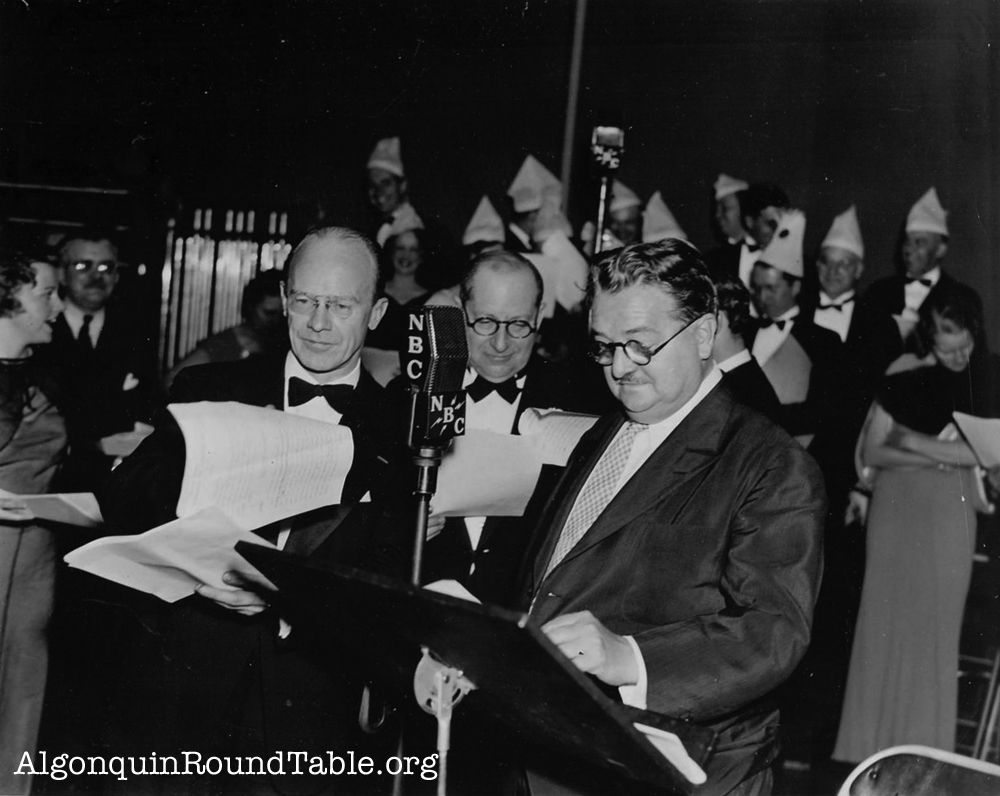
Deems Taylor, composer Sigmund Romberg, and Alexander Woollcott in the studio, circa 1935.
It turns out that there were members with careers that stretched from silent pictures to live television, such as actresses Margalo Gillmore and Peggy Wood. Robert Benchley made the first all-talking short, The Treasurer’s Report, released in March 1928 by Fox. Marc Connelly and Dorothy Parker both wrote captions and scenarios for the silents, then later jumped into writing plays and talkies.
But if there is one format that most of the members drew paychecks from after the Round Table ended, that’s radio. Many members of the group appeared as guests, commentators, writers, or actors. Benchley and Parker had their short stories adapted for dramatizations. Harpo Marx whistled his answers on-air. Others made the transition from newspapers to microphones, trading on their popularity as writers.
The book has more than 100 locations around the New York area tied to the lives of the “Vicious Circle” that met at the Algonquin Hotel on West Forty-fourth Street. Here are three spots from their radio days, all within walking distance of the Round Table.
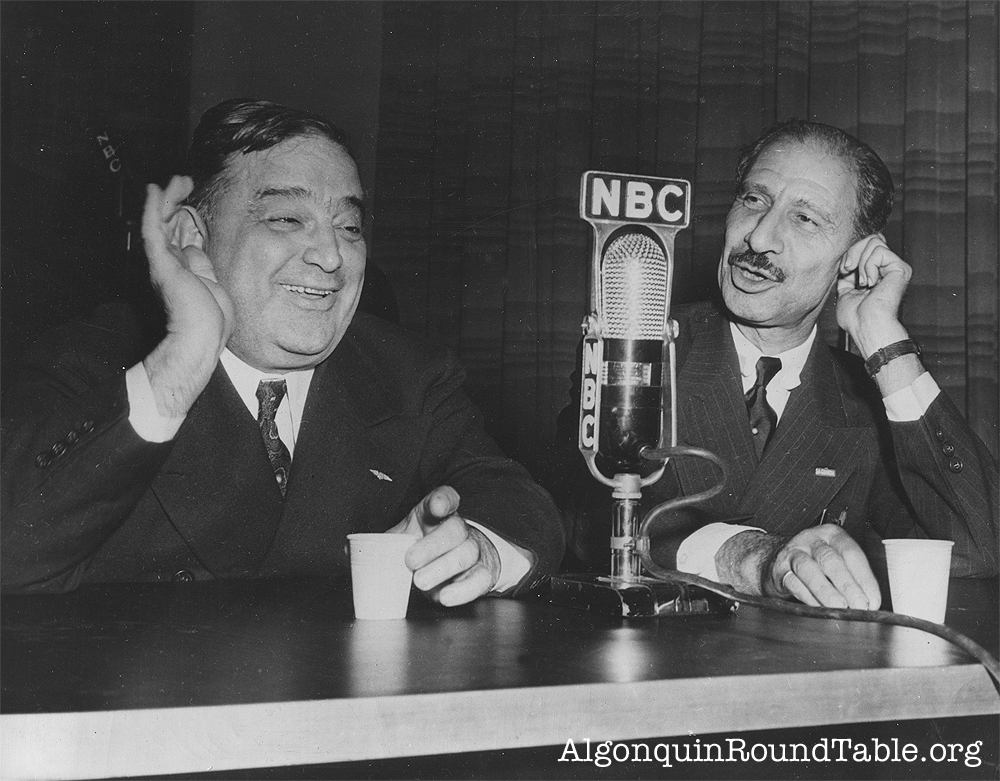
New York City Mayor Fiorello La Guardia and Franklin P. Adams on Information Please.
NBC, 30 Rockefeller Plaza
Franklin P. Adams was a veteran newspaper columnist with 35 years’ experience when his services were no longer needed. Radio saved him, and a quiz show was the last hurrah of his brilliant career. In 1937, the Herald Tribune didn’t renew his contract. With an encyclopedic knowledge of literature and trivia and a family of five to support during the height of the Great Depression, the offer to be a regular panelist on a radio quiz show came as a blessing.
The format of Information Please was simple but brilliant. Listeners mailed in questions. If the question stumped a panel of experts, the listener won a small cash prize. The show was unrehearsed and conducted before a live studio audience. The 30-minute program moved like lightning, and experts and guests had to answer quickly. On May 17, 1938, Information Please debuted on the NBC Blue Network (later ABC). Clifton Fadiman, a literary critic who wrote for The New Yorker, was master of ceremonies. The show was an overnight success, and more than 25,000 questions poured into the studios.
One question put to F.P.A. in 1938 was to finish the Joe Miller gag, “Who was that lady I saw you with last night?” To which he replied, “There are two answers: That was no lady, that was my wife. And the other is that was no lady that was your wife.” The show continued for ten years, mostly on NBC. Over time, just about every Round Table member appeared as a guest.
NBC has always been associated with Rockefeller Center. John D. Rockefeller Jr., son of the founder of Standard Oil, owned the land and helped create the landmark. The area bounded by Fifth and Sixth avenues from 48th to 51st streets contained numerous speakeasies before demolition in 1930. NBC has called 30 Rockefeller Plaza home since the building was completed in 1933, spanning corporate ownership from General Electric to Comcast. More than a dozen buildings form the complex today, with “30 Rock” as centerpiece. Radio studios were the original tenants (hence Radio City) and now television studios. The Art Deco buildings are landmarks inside and out.
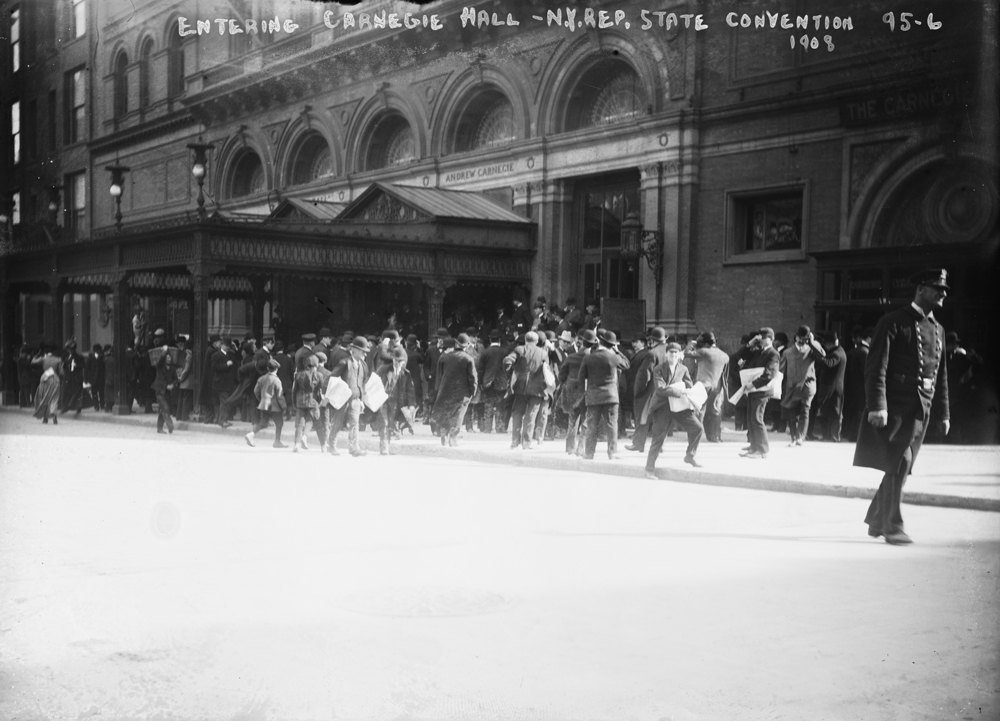
Carnegie Hall.
CBS, Carnegie Hall, 881 Seventh Avenue
When radio networks became national broadcasters in the late 1920s, some of the live programming was classical music. Symphonies and orchestras dominated as networks tried to reach upper class listeners. William S. Paley signed the New York Philharmonic to CBS in a major coup and gave the network enormous prestige.
Beginning in 1936, Deems Taylor served as commentator during intermissions. Already a star composer and conductor, he had been a newspaper music critic but never a broadcaster. His role at CBS was an enormous success, and Taylor found himself giving weekly music lecturers to a huge audience during Sunday afternoon concerts in Carnegie Hall. He helped listeners understand what they were hearing and helped a generation appreciate classical music. Taylor also introduced listener questions, interviewed orchestra members during intermissions, and brought the whole experience of classical music into the nation’s living rooms. A broadcaster for more than ten years, Taylor became the country’s best-known authority on music.
The building was saved from a wrecking ball in 1960 and underwent multi-million dollar renovations in recent years. Today the Isaac Stern auditorium, the main performance hall, seats 2,800.
CBS, 485 Madison Avenue
Alexander Woollcott loved to pontificate. He was a ham, a showman, and a natural as a radio broadcaster. He also notoriously recycled magazine articles and sold them to two and even three publications. Getting a radio show allowed him to retell those same stories to another audience and saved his career. From 1930 to 1943, Woollcott worked on the top floor in Studio One of the CBS Building. He was “The Town Crier” on panel discussion radio program, with national sponsorships. It was an early form of talk radio, with notable guests brought in and Woollcott acting as a moderator.
On January 23, 1943, a few days after he turned 56, Woollcott suffered a stroke during a live panel discussion. He was carried out of the CBS studios in his chair and brought to Roosevelt Hospital, but it was too late. A week later, a memorial service was held at Columbia University’s McMillan Academy Theatre.
In 1930, the 24-story Columbia Broadcasting Building was completed for the two-year-old CBS radio network at 485 Madison Avenue to designs by J. E. R. Carpenter. This was CBS’s home until 1965, when the company moved to the 38-story CBS Building designed by Eero Saarinen on Sixth Avenue and 52nd Street, nicknamed “Black Rock.”
***
Originally written for Cladrite Radio.
Vicious Circle Virtual Tours Begin April 3Vicious Circle Virtual Tours Begin April 3
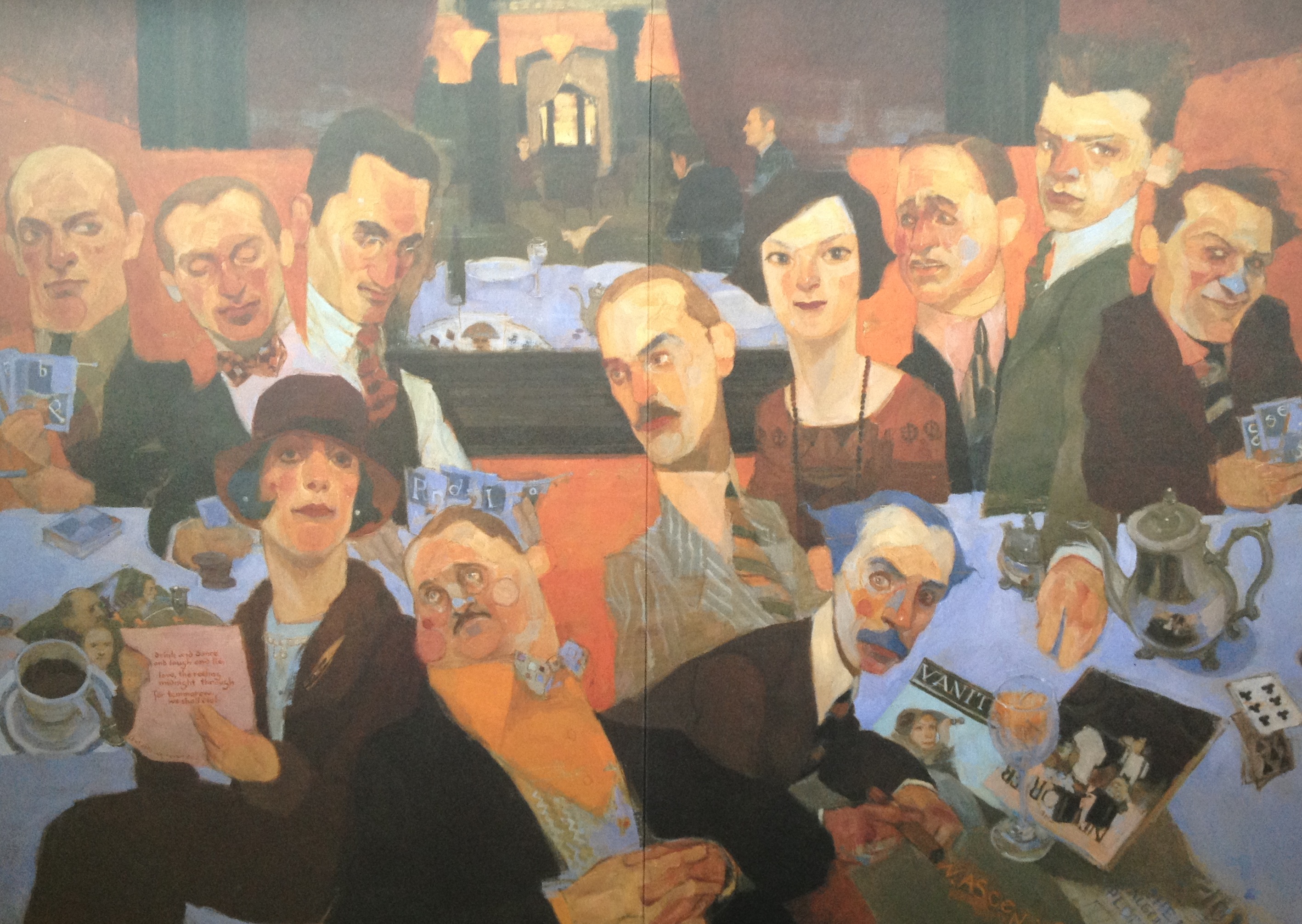
Algonquin Round Table by Natalie Ascencious
The tour will be Friday, April 3, 10, 17 and 24.
The Algonquin Round Table comes alive in the only New York tour devoted to the famed literary group. It met from 1919-1929 and is America’s most well-known group of writers. We will trace the footsteps (from your house) of the legendary wits Franklin P. Adams, Robert Benchley, Heywood Broun, Marc Connelly, Edna Ferber, George S. Kaufman, Harpo Marx, Dorothy Parker, Harold Ross, Robert Sherwood, Alexander Woollcott, and the rest of the “Vicious Circle.” The tour explore the architectural and historical stories of the buildings and landmarks linked to them.
The tour “begins” and “ends” inside the world-famous Algonquin Hotel, a national literary landmark. This 1-hour tour will visit more than 30 places. Tour Highlights:
• See the Theatre District and the landmark Broadway playhouses;
• Visit the locations of the former speakeasies of Rockefeller Center;
• See where the Round Table lived in Hell’s Kitchen during Prohibition;
• Learn about their 1920s friends such as F. Scott Fitzgerald;
• See where The New Yorker, Vanity Fair, and Vogue magazines began.
Not only will you get a taste of New York history, but it’s a great way to learn about the past and also see how little has changed over the decades.
The guide is Kevin C. Fitzpatrick. He is the author of The Algonquin Round Table New York: A Historical Guide (Lyons Press), A Journey into Dorothy Parker’s New York (Roaring Forties Press), and Under the Table: A Dorothy Parker Cocktail Guide (Lyons Press), among others. He’s president of the Dorothy Parker Society.