Algonquin Round Table History,News F.P.A. Diary Entries For His Birthday

F.P.A. Diary Entries For His Birthday

FPA

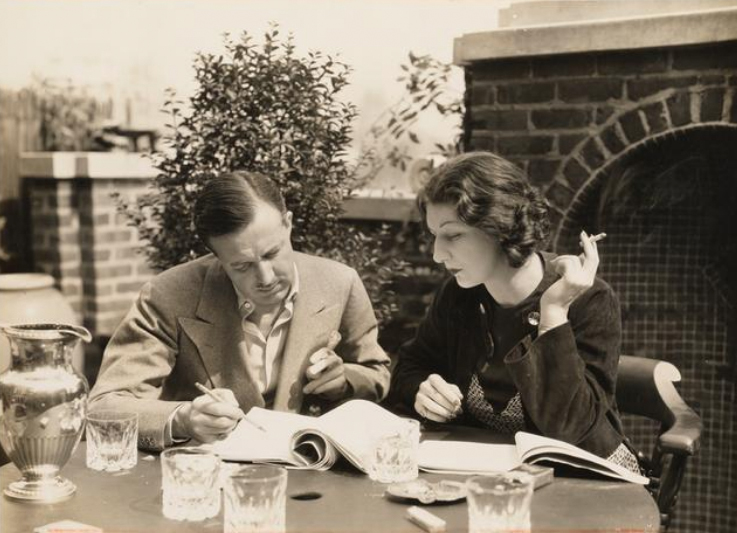
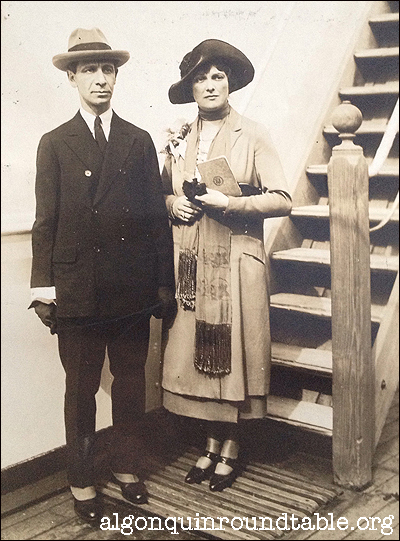
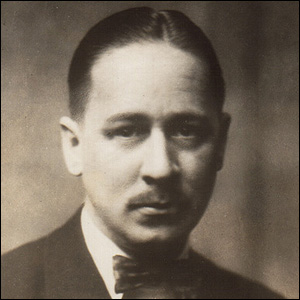
Franklin P. Adams and his second wife, Esther Root, on their honeymoon, 1925.

Franklin P. Adams wrote his diary from 1911-1941; by his estimate more than two million words. It began June 11, 1911, in the New York Evening Mail. The column was called Always in Good Humor. On January 1, 1914, F.P.A. joined the New York Tribune staff and changed the name to The Conning Tower. He remained there until December 31, 1921, when he joined The World. When The World folded, he moved to the New York Herald Tribune on March 2, 1931. His column appeared there until 1937. His column ended in the New York Post in 1941, by which time F.P.A. was a radio star on Information Please.

Editor’s note: These entries are taken directly from the collection The Diary of Our Own Samuel Pepys, published by Simon and Schuster in 1935. All of F.P.A.’s idiosyncratic spelling and grammar usage is left intact. Editorial notes in [brackets] are from the editor and in some cases F.P.A. himself. None of the entries have been altered.

Adams was born in Chicago on November 15, 1881, and died on the Upper West Side of Manhattan on March 23, 1960.

* * *
Sunday, November 16, 1919
All day in the country, and had a pleasant day, playing croquet. Home, when I find E. Ferber [Edna Ferber] and Janet Grant and Miss Rosalind Fuller [an English actress and singer]; and A. Woollcott [Alexander Woollcott], very grand in a silk hat, and H. Ross [Harold Rosss]; and we had a frugal supper, and all left before eleven. Read [William] Congreve’s poems, indifferent stuff.

* * *
Thursday, November 15, 1923
Up and to the office early away and met Mistress Beatrice Gunsaulus Merriman [spouse of Rev. Robert Noel Merriman], who has come from Bethlehem to have a birthday party with me to-day and to-morrow. So we to Dottie Parker’s, where was a great crowd gathered to honour me, and a great shower of presents, tyes, and kerchiefs and a neck-scarf. So now home with Beatrice [Kaufman] and thence to a great and gay gathering at Mistress Ruth Fleischmann’s [Quincy, IL, native, spouse of baking heir Raoul], where I had the merriest birthday party anyone ever gave me, but they told me it was H. Miller’s [Henry Wise Miller, banker, spouse of Alice Duer Miller] and G. Kaufman’s [George S. Kaufman] and A. Krock’s [Arthur Krock, newspaperman, won Pulitzer 1935] and Beatrice’s, and that Ruth and Raoul had been married this day three years, yet by 10 o’clock I was certain the party was entirely in my honor and was not disinclined to think that the universe had been constructed for the same delightful purpose. So home, despite all in the car counseling to drive with more caution, and we had to walk up the stairs, and Beatrice lost an earring, which distressed her, but I told her we should find it in the morning.

* * *
Sunday, November 15, 1925
For a walk in the warm sunshine, and to luncheon at L. Dodd’s [Lee Wilson Dodd, playwright, novelist, poet, died 1933], and my wife told a tayle of some children who, being warned not to express astonishment when the ice cream was borne upon the table, did carol forth, “We have it all the time! We have it all the time!” So by steam-train to the city, and thence to the office, and so to R. Fleischmann’s, to a great party, and met Miss Fay Compton the play-actress, as fair and sweetly spoke a lady as ever I saw.

* * *
Monday, November 15, 1926
This day my birthday, and my wife give me a fine golden knife and H. Miller give me some kerchiefs and A. Samuels [Arthur Samuels, composer, publicist, editor] some tyes, all of which I was very glad to get, not so much for the sentiment behind them as for the value and beauty of the gifts. This day Frank Sullivan back to work, and he come to see me, looking very handsome with his long rest. All day at my office, and so home and did some scrivening before dinner, and my wife telling me that I had misspelled our handmaiden’s name, calling her Dougherty instead of Doherty, so I asked her whether she were a relative of the great lawn tennis players, but she said she never had heard of them. But she is as skilful in her field as they were in theirs, and I would suggest that she would play in the final of any cooking tournament. So to the theatre in Florence Hammond’s [spouse of Herald-Tribune drama critic Percy Hammond] petrol-wagon, and saw Shaw’s “Pygmalion,” and enjoyed it all mightily, in especiall Miss Lynn Fontanne’s and Mr. Henry Travers’s acting. And I did make some vows, on this my birthday, such as to waste no more time in frivolity, and to be more kind to my fellows. Yet last night there was a discussion about murder, and some that they were incapable of killing anybody, and they thought I would be, too; but I thought there was none in that company that might not have murder in his heart at some time; and as for myself, I know many persons I would like to kill, if there were no penalty attached to the act. Lord! if I could murder those I pleased to kill, it would almost be impossible to get a taxicab in this city. So home, and read E. Pearson’s [Edmund Lester Pearson] “Murder at Smutty Nose,” a thrilling compilation, with things in it about the Parkman case, and Dr. Crippen [Hawley Harvey Crippen, the first criminal to be captured with the aid wireless], and others.

* * *
Saturday, November 15, 1930
Early up, it being my birthday, and my wife give me a crimson sweater to wear next summer, and I got letters from my sisters Amy and Evelyn, and so did my work in the morning, and in the afternoon to H. Miller’s to listen to how badly the Yales would beat the Princetons, but they scarcely beat them at all, and so we to Manhasset, to a giant birthday celebration given for me at R. Fleischmann’s, very merry and gay, and I had a pleasant time with Mrs. Delehanty [née Margaret E. Rowland, spouse of John Bradley Delehanty, noted architect], who tells me she is a girl from Phillips, Wis., and she very gifted, shewing me how she can stand on her head, and I had a talk with A. Barach [Dr. Alvan L. Barach, founder of pulmonary rehabilitation and inventor of the oxygen tent] the physician, of clairvoyancy and fortune-telling and palm-reading, we telling each other of the great success we had at these charlatanries, what with the subjects telling us all that we wanted to know, and then being astonished at our magickall powers. But it is a dangerous thing to do, forasmuch as I never shall forget the trouble that I got into by telling a girl that she did not have confidence enough in herself, which is a thing that everybody believes about himself, especially those that have more confidence than they should have. It is also safe to tell people that they are too generous and too tender-hearted. So late to bed, and waked my wife, albeit I was quiet as a million mice.

* * *
Sunday, November 15, 1931
Lay mighty late, and so up and wondering what would be happening on November 15, 1981, I then being 100 years of age, but I fear that this will be the last time that there will be a legal holiday on my birthday, and so read the newspapers with great misgivings about what is going on in Manchuria, and would forecast that a year from now matters will be more troubled and unpeaceful than they are now, and so talked with A. Krock and R. Fleischmann about history and its teachings, and Krock said that he was proficient in its study when he was a boy forasmuch as it was taught with a stress upon dates of wars and deaths of kings and history made so little impression upon me that I forget how it was taught. But I feel that it ought to be taught backwards; that is, that the study should begin with the front page of today’s newspaper and go on from there to last year, and that it might then seem important and personal to the student to read about the Spanish Armada and Eric the Red and the Battle of Stirling and Ticonderoga and General P. T. G. Beauregard and Bannockburn and Themistocles and Hadrian and Ypres and Rutherford B. Hayes and Aguinaldo and the Guelphs and the Franco-Prussian War. So in the afternoon my wife and I beat H. Miller and R. Fleischmann two deuce sets, and in the evening had a very merry birthday party, almost everybody having been born a few years ago today, yesterday, and tomorrow; and so A. Woollcott drove me to the city in a cab, and told me many fascinating things, he being no less laconic than ever, and about how Herbert Wells, the author, had come to see him, and of many other things.
Related Post

Laurence Stallings

A Look at Laurence Stallings, WriterA Look at Laurence Stallings, Writer

Laurence Stallings

Laurence Stallings

Laurence Tucker Stallings is mentioned about three times a year by the pop culture world. Usually it has to do with his screenwriting hits The Big Parade or She Wore A Yellow Ribbon appearing on television. There has only been one book about him, a not very good academic tome (by Joan T. Brittain, Laurence Stallings, Twain, 1975). When I was working on the book, I did reach a person who was connected to his late children. The man was so unhelpful, and unpleasant, that I am still incredulous at his lack of wanting to perpetuate the life story of Stallings. Today is the anniversary of his birth, in 1894, which is a good reason to present some of my information about him.

I’ve always liked the Stallings story. He served as a U.S. Marine in World War I, and was grievously wounded. Stallings joined the staff of the New York World in 1922 to write book reviews and editorials. The war veteran was passionately liberal; when he referred to a black man as “Mr.” in print, he angered readers in his Georgia hometown.

Stallings and Maxwell Anderson were both working at the World when they decided to collaborate on a play. Stallings, who’d lost a leg in combat as a Marine, knew he wanted to write an antiwar drama. The pair co-wrote What Price Glory? for producer-director Arthur Hopkins, and it exploded at the Plymouth Theatre on September 5, 1924. It was the first play to use the profanity-laced speech of soldiers, and its grim view of war was riveting. The story of First Sergeant Quirt (William Boyd) and Captain Flagg (Louis Wolheim) in the trenches of France, the script used Stallings’ experiences in World War I. It ran for 433 performances and got the playwrights contracts in Hollywood.

Not much is ever written about him, and a lot is not accurate or focuses just on his movies. Here is a little more on an overlooked American writer.

The Algonquin Round Table considered Laurence Stallings a hero because of his sacrifices as a WWI combat veteran; many members had also served in the A.E.F. His combat experience would provide him the inspiration to write passionately about war in a bestselling book, a gritty Broadway drama, magazine stories and fiction, and a smash hit silent film.

Laurence Tucker Stallings, Jr., was born November 25, 1894, in Macon, Georgia. He graduated from Wake Forest with a B.A. in 1915. His first job was a reporter on the Atlanta Constitution in 1915.

In 1917 Stallings enlisted in the Marines and was sent to France, where he participated in some of the bloodiest campaigns of the war. He received a battlefield commission, and took over command of a Marine outfit. At the Battle of Belleau Wood near the Marne River, Stalling was wounded in June 1918. Awarded the Purple Heart and the Croix de Guerre, Stallings spent eight months recovering in France before being shipped home after the Armistice was signed.

Once home, he married his college sweetheart. Helen Poteat was the daughter of the Wake Forest president, William Louis Poteat. The wedding was on March 6, 1919, at the campus in Winston-Salem. After the wedding, the couple moved to Washington, D.C., where Stallings joined The Washington Times as a reporter and earned his M.A. from Georgetown. His writing career was taking off, however, Stallings never fully recovered from his combat injuries, and in 1922 had to have his right leg amputated.

Laurence Stallings

Laurence Stallings

After recuperating Stallings and his wife moved to New York, where he joined the World. A tall, dark-haired, good-looking Southerner, Stallings sometimes came to the Algonquin Hotel wearing his artificial leg, other times he’d walk in on a crutch. His newspaper co-workers Heywood Broun and Deems Taylor introduced him to the Vicious Circle after it was an established institution.

In 1924 Stallings was writing book reviews three days a week for the World. He was tapped by executive editor Herbert Bayard Swope to be on the “Op. Ed” page with Franklin P. Adams, Heywood Broun, Frank Sullivan, and Alexander Woollcott. He shared an office with Maxwell Anderson, at the time a fellow editorial writer. They collaborated on their first play, What Price Glory? for the powerful Broadway producer Arthur Hopkins, who’d also staged Don Marquis’ hit play The Old Soak. With What Price Glory? Stallings was able to share his real-life experiences about the trauma and heartbreak of soldiers in combat. It was a hit at the Plymouth Theater, 236 West 45th Street, and ran for more than a year.

But he was not finished with the Great War. His novel, Plumes, was a contender for the 1925 Pulitzer Prize, but it was edged out by another Algonquin regular, Edna Ferber, for her novel So Big. Broun weighed in on the subject in his column:

“I have heard that Plumes, by Laurence Stallings, was the second choice of the committee, but this is not official, as the body does not announce any honorable mentions. At any rate, Plumes should be high up on the list. There are things in Plumes which seem to me better than any portion of So Big, but it is a less evenly developed book and is justly placed below Miss Ferber’s novel. If there were such a thing as a pentathlon, or all around prize, Laurence Stallings could not be shut out from victory, since he wrote a novel which proved a contender and collaborated with Maxwell Anderson on a play which ranked near the top.”

His novel was adapted for the silent movie epic The Big Parade that same year, and was among the first blockbusters in the pre-talking pictures era. Directed by maverick filmmaker King Vidor, The Big Parade played to sell-out crowds across the nation. A railroad car was used to transport the orchestra, lighting, and personnel from town to town. The film, made just seven years after the conflict, was the first to show the gritty side of the war on the big screen. The central character, played by John Gilbert, like Stallings, also loses a leg in battle.

Stallings and his wife had two children together during their rocky 17-year marriage. In December 1936 Stalling’s wife sued him for divorce in Reno, Nevada, charging him with cruelty. In a private trial a judge granted the divorce and the 17-year union was over. He walked away from his family and gracious estate in North Carolina, and never saw them again. Stalling was free to marry a girlfriend, Louisa St. Leger Vance, a 25-year-old writer. On March 18, 1937, the couple was married in Manhattan at her parents’ home, 410 East 57th Street. They had two children. Stallings moved to Hollywood, where he remained for the rest of his life.

In the 1930s Stallings had a tumultuous decade. He couldn’t choose between literature or motion pictures. He was close to Robert Benchley and could be spotted at “21” together; both men had the same issues of working for art or commerce. In 1934 Stallings became an editor of Fox Movietone News (offices 460 West 54th Street), and resided at 50 East 77th Street. In 1935 Fox sent him to Ethiopia for what turned out to be a two-year assignment. He was looking for the start of the next war with four cameramen and 50,000 feet of film as they waited for Mussolini to invade. Stallings filed stories for the New York Times on the conflict, and then returned home to America. He abandoned his first wife and two small daughters after his 1937 remarriage. When the U.S. entered World War II, Stallings went back on active duty with the Marines in 1942. He served as an intelligence officer in the Pentagon, and attained the rank of lieutenant colonel.

Laurence T. Stallings gravesite. Photo: Nigel Quinney.

Laurence T. Stallings gravesite. Photo: Nigel Quinney.

Stallings returned to California to write screenplays, magazine articles, and books. He lived in Pacific Palisades and his health deteriorated. Doctors had to remove his other leg in 1963, the same year he published a stirring account of World War I, The Doughboys. Stallings died on February 28, 1968, at his home. He received a military burial with a Marine Corps honor guard. Stallings is interred outside San Diego in Ft. Rosecrans National Cemetery.

Adapted from The Algonquin Round Table New York, A Historical Guide (Globe Pequot Press). Order the book here.

Bedtime With The Algonquin Round Table

Bedtime with the Algonquin Round TableBedtime with the Algonquin Round Table

natalie ascencious

The Algonquin Round Table by Natalie Ascencious.


For those trapped indoors now there is relief coming from 1920: Weekly “Bedtime with the Algonquin Round Table” to be held on live video conference via Zoom, hosted by Kevin C. Fitzpatrick, author of The Algonquin Round Table New York: A Historical Guide and A Journey into Dorothy Parker’s New York.

The schedule will be 9:00 p.m. Eastern; check your time zone to watch live via the World Clock. The schedule is April 1, April 8, April 15, April 22, and April 29. The stream is free to watch but you must watch via Zoom.

Join Zoom Meeting Here
Meeting ID: 481 153 606
Password: 1920

Bedtime With The Algonquin Round Table

Bedtime With The Algonquin Round Table

Each week we will hear about different members of the Algonquin Round Table, which began meeting in June 1919 at the Hotel Algonquin. There is a list of members here. You will find out about them, hear stories they wrote or worked on, and have a fun time as we take a deep dive into New York City history. You can participate in the live chat, ask questions, and engage with others if you wish. All events are pet friendly.

Each week you can get clues about who we will be hearing about via Instagram on the Dorothy Parker Society Instagram account here.

April is also National Poetry Month, so we will talk a lot about the poets and writers of the group. If you have any questions, contact us or post it on Facebook or Instagram.

Walk in the Footsteps of the Algonquin Round Table in New Guide Book to Jazz Age Writers & WitsWalk in the Footsteps of the Algonquin Round Table in New Guide Book to Jazz Age Writers & Wits

Algonquin Round Table New York: A Historical Guide (Lyons Press)

Algonquin Round Table New York: A Historical Guide (Lyons Press)

New York—Retrace the steps of the legendary wits that convened at the Algonquin Hotel in 1919 who called themselves the Vicious Circle. THE ALGONQUIN ROUND TABLE NEW YORK: A HISTORICAL GUIDE is the first book to fully explore the whole group and their world. It’s packed with photos and maps.

“That is the thing about New York,” wrote Dorothy Parker in 1928. “It is always a little more than you had hoped for. Each day, there, is so definitely a new day.”

Now you can journey back there, in time, to a grand city teeming with hidden speakeasies, luxurious Broadway playhouses, and dazzling skyscrapers. In these places, Parker and her cohorts in the Vicious Circle sharpened their wit, polished their writing, and captured the energy and elegance of the time. Robert Benchley, Parker’s best friend, became the first managing editor of Vanity Fair before Irving Berlin spotted him onstage in a Vicious Circle revue and helped launch his acting career. Edna Ferber, creator of bestselling melodramas, wrote the Pulitzer-winning So Big as well as Show Boat and Giant. Jane Grant pressed her first husband, Harold Ross, into starting The New Yorker. Herman Mankiewicz was a Times wage slave who soaked up the atmosphere, later pouring it into his screenplay for Citizen Kane. Parker wrote for Vanity Fair and Vogue before ascending the throne as queen of the Round Table, earning everlasting fame (but rather less fortune) for her award-winning short stories and unforgettable poems. These are a few of the thirty figures from backstage Broadway to newspaper city rooms in the book.

Explore their favorite salons and saloons, their homes and offices (most still standing), while learning about their colorful careers and private lives. Packed with archival photos, drawings, and other images—including never-before-published material—this illustrated historical guide includes current information on all locations. Use it to retrace the footsteps of the Algonquin Round Table, and you’ll discover that the golden age of Gotham still surrounds us.

About the Author
Kevin C. Fitzpatrick (author), president of the Dorothy Parker Society, is the author of Under the Table: A Dorothy Parker Cocktail Guide (Lyons Press). He has been leading walking tours from the Algonquin Hotel for 15 years. Visit him at fitzpatrickauthor.com.

Anthony Melchiorri (foreword) is the creator and host of Hotel Impossible on the Travel Channel. A former general manager of the Algonquin Hotel, he has twenty years experience at the top hotels in the industry.

To Pre-Order: The Algonquin Round Table New York: A Historical Guide, by Kevin C. Fitzpatrick, (Lyons Press January 2014; ISBN: 978-1-4930-0757-8)