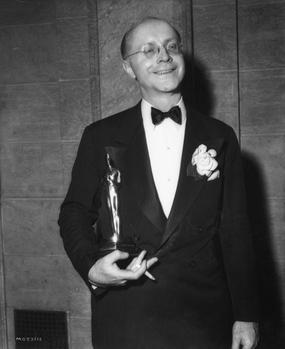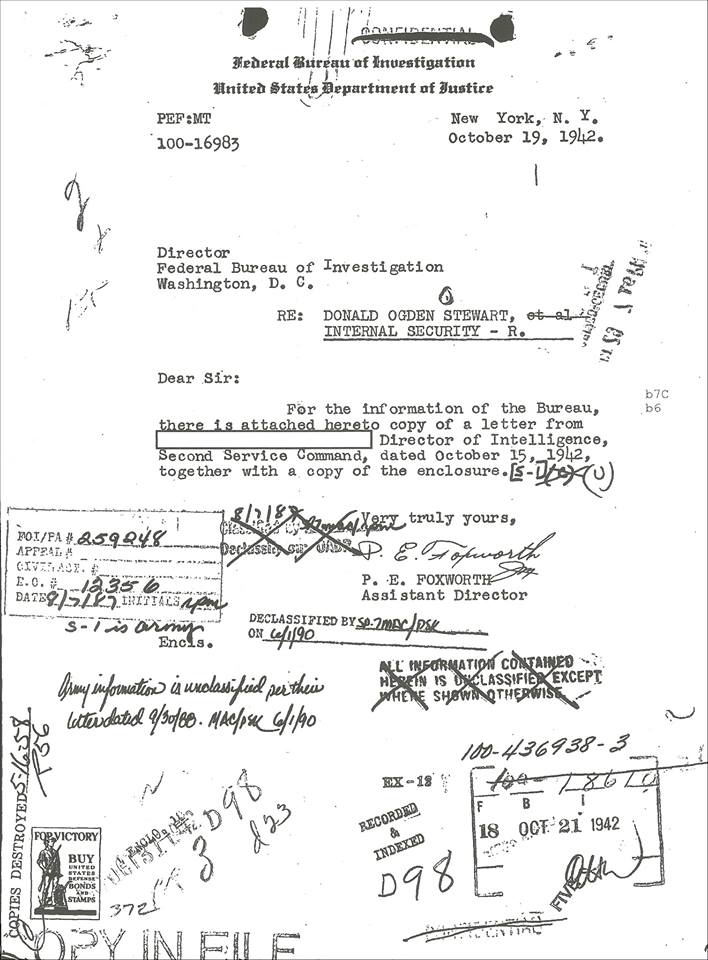
On This Date October 19, 1942: The FBI file on Donald Ogden Stewart is more than 1,000 pages. I conducted a Freedom of Information request several years ago to get it all. The government kept tabs on him for 30 years. I have some of it in the new book. Of all the Algonquin Round Table members, Stewart paid the biggest price for his political beliefs and convictions.
Donald Ogden Stewart in Hot Water
Related Post
Frank Sullivan of Saratoga SpringsFrank Sullivan of Saratoga Springs
After the demise of the New York World in 1931, Algonquin Round Table member Frank Sullivan moved home to Saratoga Springs and became the ultimate freelancer. In a small clapboard house shared with his sister at 135 Lincoln Avenue, he turned out marvelous humor pieces for the rest of his career. “Once I visited New York for twenty years but I wouldn’t live there if you gave me Philadelphia,” he wrote. “A small town is the place to live. I live in a small town 180 miles from New York and while I would not say it has New York beat by a mile I would put the distance at six furlongs.”
Over the years, New Yorkers such as Harold Ross and Marc Connelly visited Sullivan, who took them to the racetrack, two blocks from his house, which treated him like royalty. He picked up the nickname “The Sage of Saratoga” and worked until his early eighties. He wrote for The New Yorker for fifty years as well as the Times sports section, the Saturday Evening Post, and Town & Country, his work collected in half a dozen books.
Sullivan suffered a series of falls in his home, and his health deteriorated. He died in Saratoga Hospital on February 19, 1976, at age 83. He is buried in the family plot St. Peter’s Cemetery in Saratoga Springs.
Today he is immortalized with a street sign nearby the racetrack, Frank Sullivan Place. His house was named a literary landmark, and is privately owned.
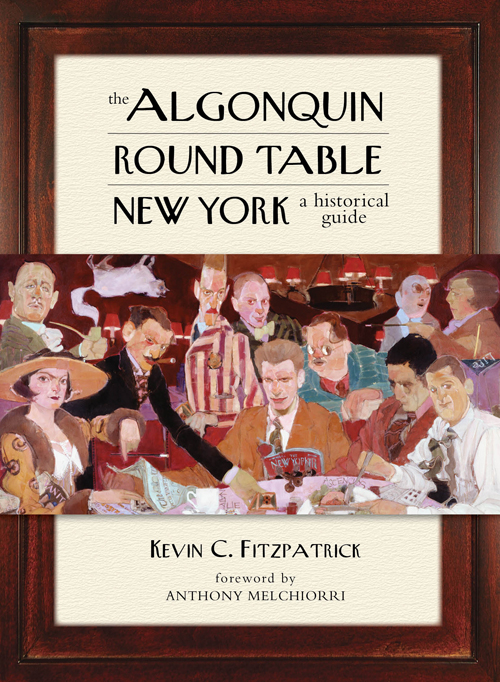
Adapted from The Algonquin Round Table New York, A Historical Guide (Globe Pequot Press) available here.
Centennial of Abie’s Irish RoseCentennial of Abie’s Irish Rose

Marie Carroll, Robert Williams, Harry Bradley, Alfred White, John Cope and Howard Lang in scene from Abie’s Irish Rose. Credit: Billy Rose Theatre Division, The New York Public Library.
Today the New York Times published a very thorough and detailed account of the centennial of Abie’s Irish Rose, a hit show 100 years ago that the Algonquin Round Table by turns roasted and scorned. The article quotes Robert Benchley and Alexander Woollcott, with a passing reference to another Vicious Circle member, Harpo Marx.
Opening a few days after St. Patrick’s Day 1922, Abie’s Irish Rose was the miracle show of the decade. Despite withering reviews and serving as the butt of jokes all over town, it ran for 2,327 performances—five years and five months. Anne Nichols wrote the unpretentious comedy allegedly based on a real-life story of a mixed-marriage she heard about. In her story, young Abraham Levy brings home from the war his blushing bride, Rosemary Murphy, a girl he met in France while she was entertaining the doughboys. But knowing how his family would take the news, he introduced her to his parents as Rosie Murpheyski. In the next act the Murphy clan comes over for a visit, and hilarity ensues.
The show appealed to audiences everywhere; at one time six road companies were touring the United States and others were in England and Australia. The playwright raked in more than $6 million and eventually had to cut down on the road companies because the income taxes were crushing her. All the major critics blasted the show, with the exception of Alexander Woollcott. One standout, and long-suffering, reviewer was Robert Benchley. He had to compose a few lines each week for a capsule review in Life. Among his finest gems were, “People laugh at this every night, which explains why democracy can never be a success,” and “Where do the people come from who keep this one going? You don’t see them on the streets in the daytime.”
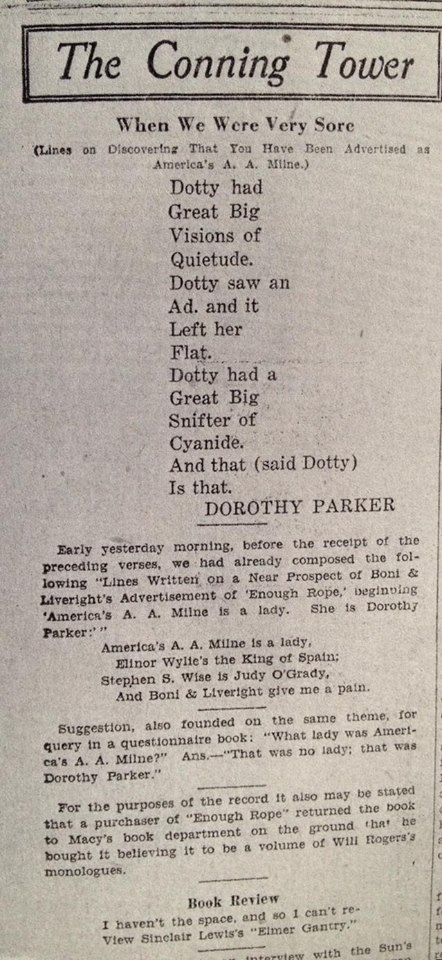
Dorothy Parker, who is not included in the article, was working for Ainslee’s at the time. She lumped it in with another play of a similar type. In September 1922, she wrote, “And then there came, in quick succession, The Rotters and Abie’s Irish Rose. Despite its having one night’s start on its opponent, The Rotters was defeated by Abie’s Irish Rose for the distinction of being the season’s worst play.”
As the Times points out, no modern theater company is currently interested in a revival of Abie’s Irish Rose. Which may be a good thing.
The Dorothy Parker reviews from the era are collected in Dorothy Parker Complete Broadway, 1918-1923.
Marking the 75th Anniversary of the Death of Robert BenchleyMarking the 75th Anniversary of the Death of Robert Benchley
Throughout World War II Benchley kept up an extremely busy pace in Hollywood. He lived in a bungalow in the Garden of Allah and worked steadily in movies and radio. In his early fifties Benchley eventually suffered from health problems exaggerated by his heavy drinking. He was diagnosed with cirrhosis of the liver and high blood pressure. In late 1945 he returned to New York for a break, but his health slid downhill. He collapsed in his room at the Royalton Hotel on West Forty-fourth Street. He died in the Harkness Pavilion at the Columbia University Medical center on Fort Washington Avenue, on November 21, 1945.
Following a private service his body was cremated and the ashes were given to his family. At the cemetery in Nantucket, however, the family discovered that the urn was empty. When the correct cremains were located, his ashes were interred properly. His headstone, chosen by his son, Nat, was carved with his New Yorker byline, an em dash before his name. His beloved wife, Gertrude, is buried next to him. She died in 1980.
Today, what is the legacy of Robert C. Benchley, 75 years after his death? Many of his humor columns were collected in best selling books. They are all long out of print. No major publisher is publishing his work; his words live on in digital archives maintained by his two most famous magazine affiliations, Vanity Fair and The New Yorker. His words do reach new audiences decades after his death; earlier this month the humorist and television writer Merrill Markoe told New York magazine that Benchley was a major influence on her style.
If anyone new to Benchley–born in the last 25 years–they would probably first discover him on TCM. His movies appear often. You can press a button and stream him right now on Disney+ and watch The Reluctant Dragon. The Robert Benchley Society, founded by David and Mary Trumbull in 2003, is the only organization keeping his spirit alive. Like some of his peers from the Algonquin Round Table–Marc Connelly, Deems Taylor, Alexander Woollcott–Benchley is teetering on being lost to history, remembered only by those hardcore old comedy fans that keep talking about him in the way we reminisce about things we’ll never see, such as Vaudeville and the Ziegfeld Follies.
Benchley was a teetotaller until he fell in with the Vicious Circle in the Speakeasy Era in his thirties. Twenty years later, drink did him in. Is it appropriate to raise a glass to him? Since we cannot sit at his table at “21” today, I think it’s more than appropriate, the milestone of today demands it.
For more about Robert Benchley, read The Algonquin Round Table New York: A Historical Guide (Lyons Press), out now in paperback.