On This Date 1955: Harpo Marx in Leonard Lyons syndicated column 29 Aug 1955.
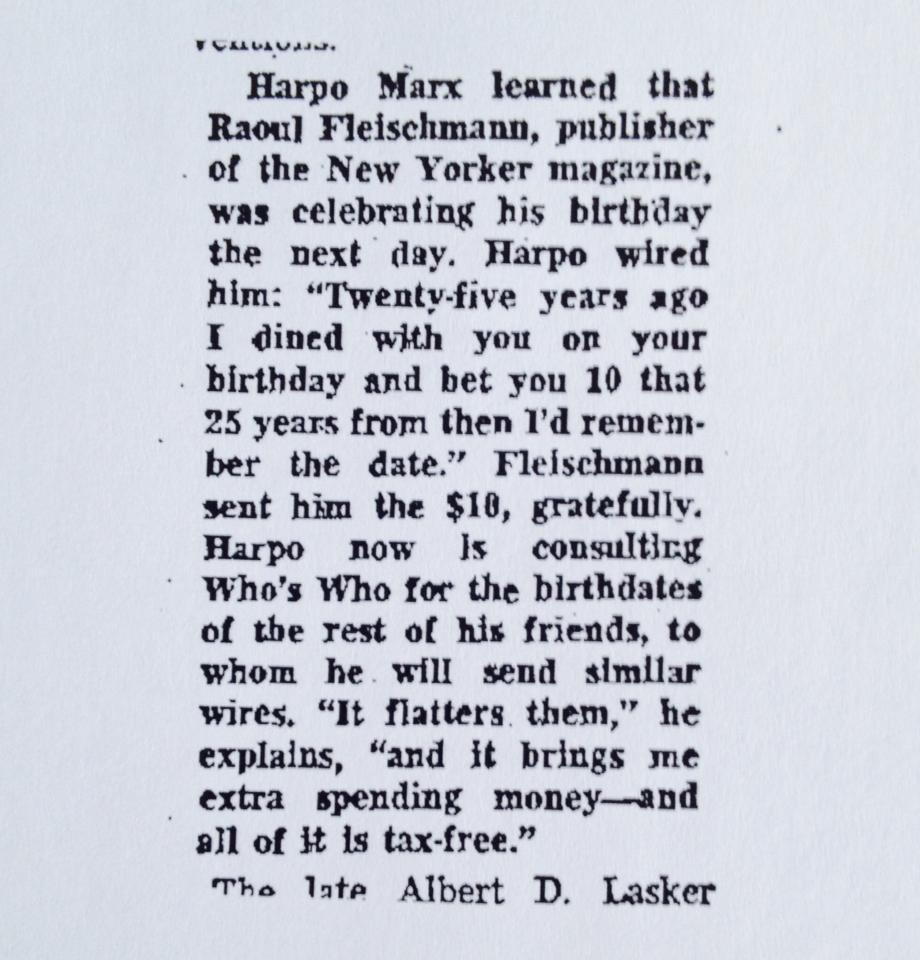
Leonard Lyons 1955
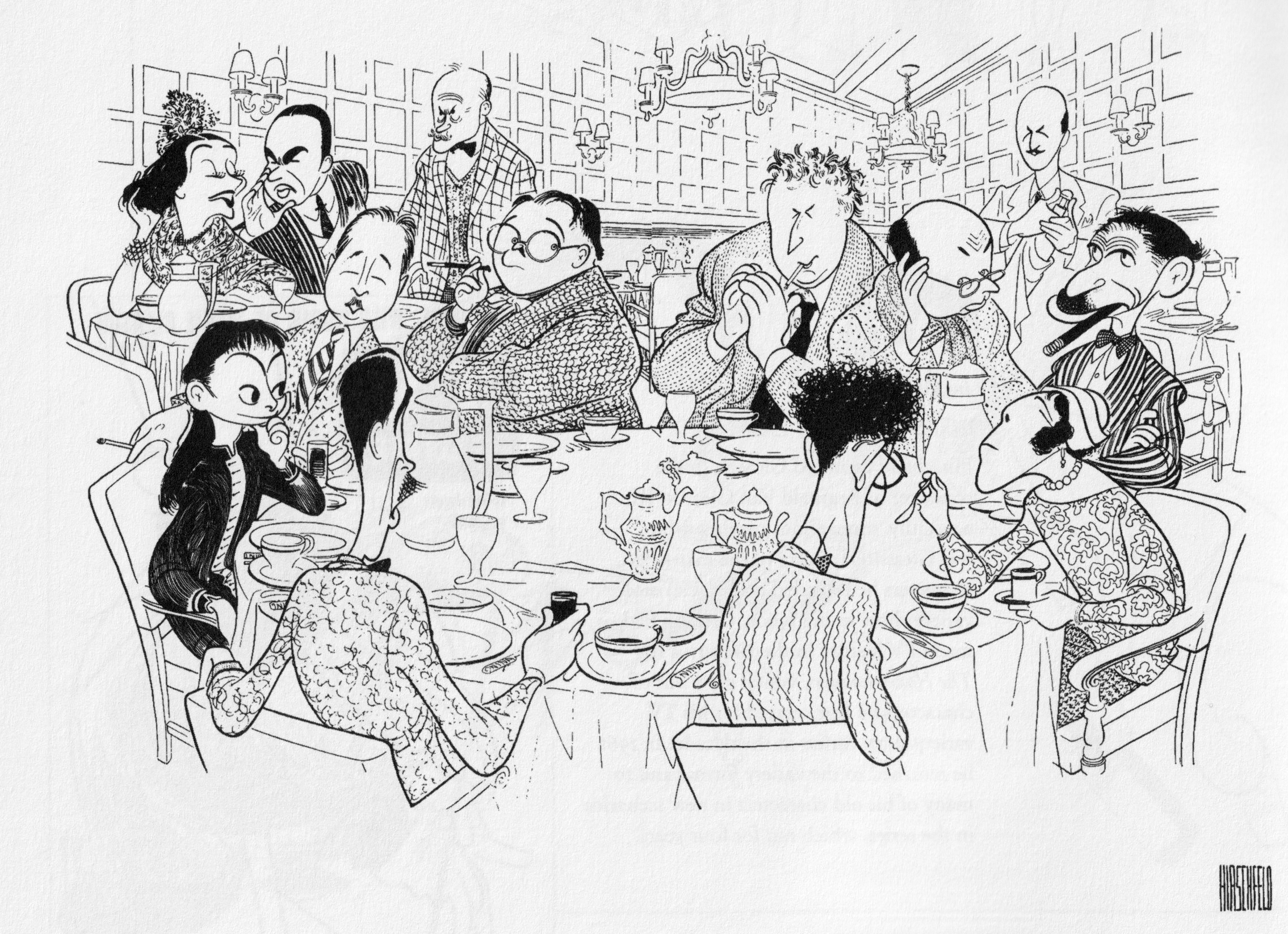
Kudos to David Leopold and Katherine Marshall-Eastman, co-hosts of the excellent Al Hirschfeld Century Podcast. The new episode celebrates the centennial of the Algonquin Round Table, which began in June 1919. There is currently the third annual Hirschfeld gallery of art on display in the Algonquin Hotel lobby. David and Katherine, who run the Al Hirschfeld Foundation, review most of the names in the famous drawing of the Vicious Circle from 1962. David has an encyclopedic knowledge of old shows and stars, and ticks off the history of all the members. Katherine displays an excellent knowledge of people who have been dead for 75 years, and gamely plays along while David schools her in Algonquin trivia. It’s a fantastic podcast. Be sure to visit the hotel while you can to see the artwork on display.
This guest blog was written for Literary Manhattan.
I love literary landmarks. I seek them out whenever I possibly can. I’m the kind of person who can’t pass a plaque or historical marker and not stop for a look, and when the site is tied to an author or book, it’s even better. When I was writing my new book, The Algonquin Round Table New York: A Historical Guide, I decided to make it a guidebook to everything related to the Vicious Circle in New York: their homes, offices, speakeasies, theaters, and related locations.
Several of the locations in my book have ties to the Pulitzer family that are shared here. If you have never been to Woodlawn Cemetery, take a trip to the beautiful landmark in the Bronx. The Pulitzer graves are incredibly touching to see placed there.
Here are two in Manhattan that you might want to visit if you get the opportunity. I enjoyed putting them in the book because they show that even though there is no longer a Pulitzer newspaper in the city, his literary landmarks are still around us.
The New Yorker has a long history of sticking its nose into matters of frivolity around New York City, and the magazine loves a good crusade. E. B. White complained vociferously about advertising in Grand Central Terminal, and editor Harold Ross, a commuter, testified at a city hearing against public address announcements in the terminal.
The magazine also took up the cause of the dirty bronze statue of Pomona, goddess of abundance, outside the Plaza Hotel in Grand Army Plaza. When New York World publisher Joseph Pulitzer died in 1912, he bequeathed $50,000 to build it. Carrere & Hastings designed the Italian Renaissance-style fountain, which was dedicated in 1916. But in The New Yorker of April 18, 1931, poet Arthur Guiterman complained that the fountain was a mess. The last stanza of “Letter to Mr. Pulitzer” reads:
One hates to speak this way about a lady,
But she is obviously much too shady;
Though still quite young, a good bit under thirty,
No nymph was ever quite so black and dirty
In all New York; so you, sir, as her guardian
(You see I’m Mid-Victorian, not Edwardian),
Should personally scrub her form and face in
The sudsy foam of her own fountain basin.
A few weeks later the magazine published a response by Pulitzer’s son, Ralph, publisher of the World:
For know! The lady’s guardians ad litem,
Aroused by her attempts to mock and spite ’em,
Have joined the city in a contribution
To give her an immaculate ablution;
To scrub her from her head, with all its wet locks,
Clear down her contours to her very fetlocks.
Ralph Pulitzer donated $30,000 to restore the statue. Doris Doscher, the model who posed for sculptor Karl Bitter as Pomona, wrote to the New York Times: “I want to take this opportunity to offer my thanks to Mr. Pulitzer for enabling me to again stand exalted—and scrubbed—above the grounds on Fifth Avenue, generously spurting precious, clear water—flush, in these times of dried-up prosperity.”
The saga of the statue and Pulitzer Fountain is a long-running city drama. It was renovated in 1971 but, due to faulty plumbing, went dry for six years in the 1980s. In 1989, $3.3 million was raised privately to restore it yet again.
The World stood at 63 Park Row, with editorial offices on the eleventh floor of a tower that Pulitzer erected in 1890. A golden dome topped the 309-foot tall building. Pulitzer died in 1911, and the paper ran along for twenty more years.
Star reporter Herbert Bayard Swope became executive editor in 1921 and brought in the best talent, increasing high-quality reporting and also hiring New York’s first black reporter. By the time the Round Table came to it, the highly respected World was the “newspaperman’s newspaper.” Swope receives credit for creating the page opposite the editorial page—the “Op. Ed.”—a phrase he coined. Onto this page he brought a lively mix of writers, most from the Vicious Circle. Among the first of them to write for the World was Robert Benchley a month after he quit Vanity Fair in 1920. Benchley’s book reviews often had nothing to do with the books themselves and could easily contain ruminations on train schedules.
Swope stole both Heywood Broun and Franklin P. Adams (known as F.P.A.) from the Tribune in 1921. The 33-year-old Broun could write anything, from a play review to a recap of the Harvard-Yale football game. He had free rein in his column “It Seems to Me,” which ran for six years, to discuss books, sports, movies, or politics. The last of these landed him in hot water. When F.P.A. brought his famous “Conning Tower” to the Op. Ed. Page, it caused a sensation. Ralph Pulitzer and his brothers broke the family trust by court order in 1931 and sold the newspaper. It put more than 3,000 people out of work.
Today no plaque or monument marks the former Pulitzer Building and its wonderful gold dome. Before it was razed in 1955, Swope and F.P.A. toured the deserted newsroom one last time. It is now a highway approach to the Brooklyn Bridge. The stained glass windows from the city room were moved to Columbia University’s Journalism School building, 2950 North Broadway, where, each year in the World Room, the Pulitzer Prize winners are announced.
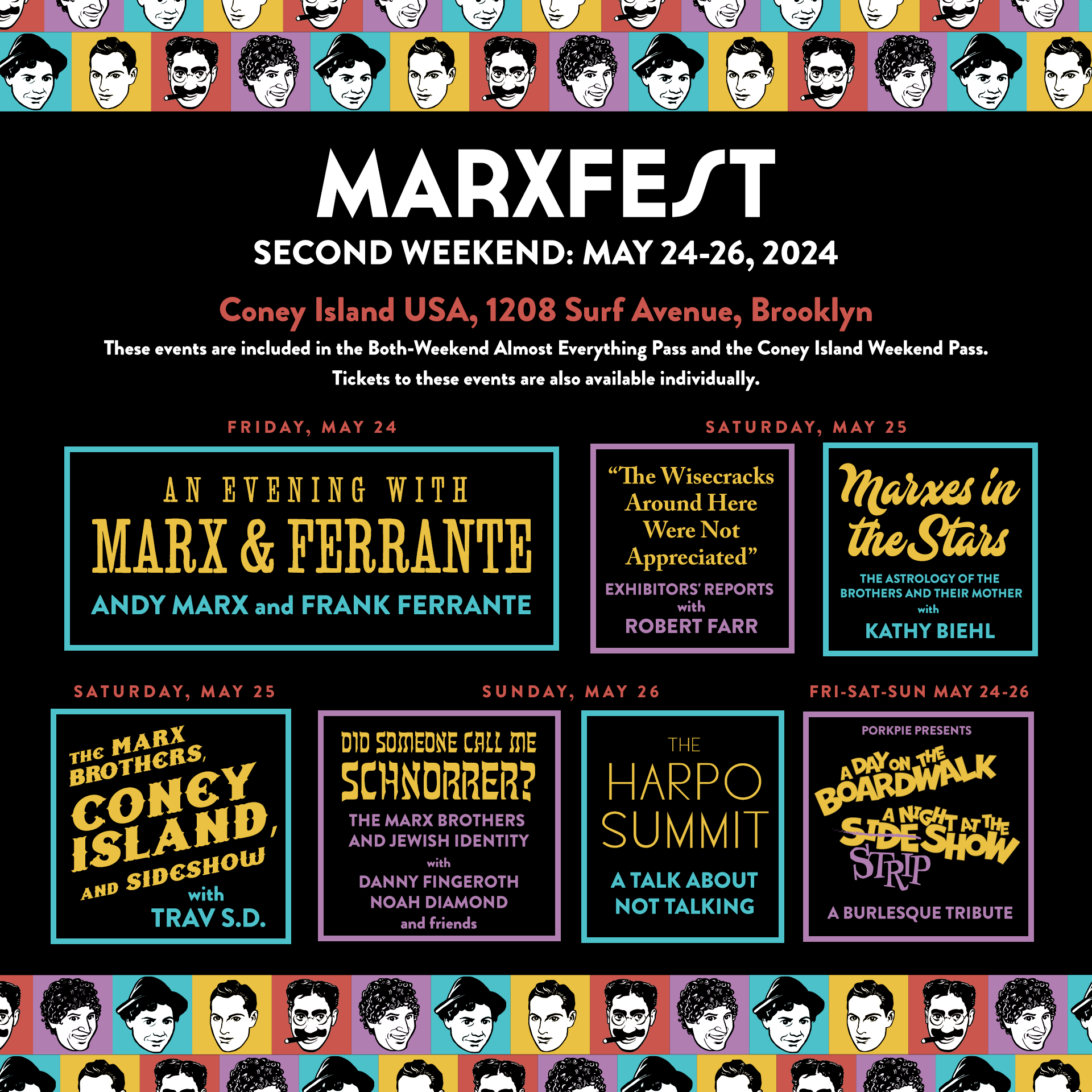
The Marx Brothers Festival Marxfest returns in May in time to celebrate the centennial of their first Broadway hit, I’ll Say She Is. There will be activities over May 17-19 in Manhattan and May 24-26 in Coney Island. Tickets go on sale April 2.
The lineup of events was revealed this week for what is the nation’s biggest and most complete celebration of the Marx Brothers. It follows ten years after the 2014 Marxfest by the same organizers.
Participants include Tony and Emmy nominee Robert Klein, The New Yorker staff writer Adam Gopnik, Marx Brothers biographer Robert S. Bader, New York Times comedy columnist Jason Zinoman, performer and director Frank Ferrante, revivalist Noah Diamond, author of “The Marx Brothers Miscellany” Trav S.D., and Groucho’s grandson, Andy Marx.
“This edition of Marxfest features more than twenty events, headlined by Marx Brothers experts, celebrated authors and journalists, and showbiz legends,” Diamond said. “It’s been a hundred years since the Brothers made their Broadway debut, but their influence on the culture of New York City goes on and on.”
Trav S.D. opined, “The greatest convocation of dyed-in-the-wool Marx Brothers lovers since the Jazz Age — and with more bearded professors than Horse Feathers!”
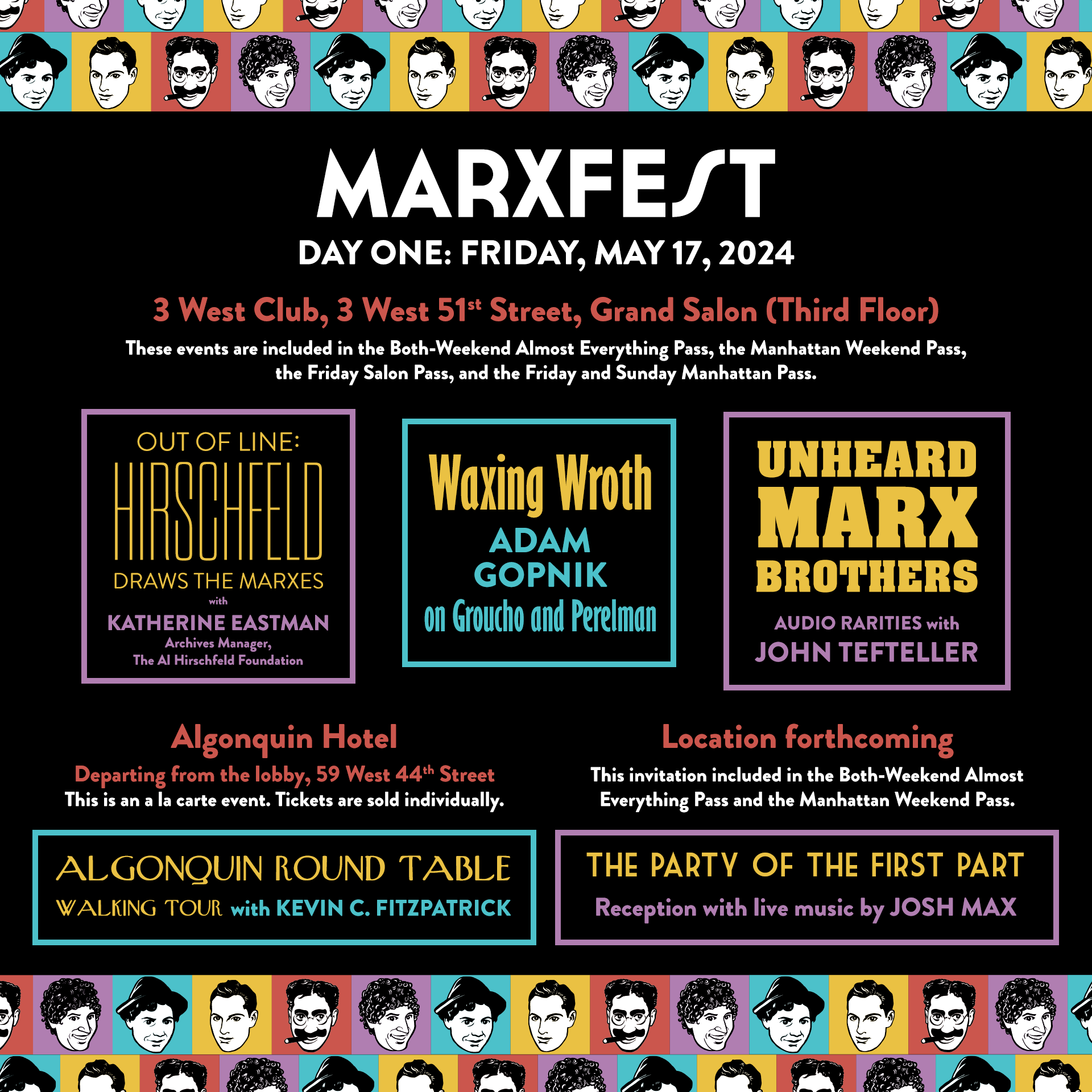
Programming for May 17 includes “Out of Line: Al Hirschfeld Draws the Marxes & Friends” presented by Katherine Eastman the Al Hirschfeld Foundation archives manager, Adam Gopnik on the relationship between Groucho and S.J. Perelman, and “Unheard Marx Brothers” audio rarities by archivist John Tefteller. The Party of the First Part, which features music by Josh Max, will close out the opening day celebrations.
 On May 18, events will include “Saturday Morning Cartoons,” an animated look at the Marxes; Trav S.D.’s salon “The Marx Bros: Vaudeville, Silent Film & Broadway;” “You Brett Your Life, a Marx trivia hour hosted by Brett Leveridge;” The Marx Brothers on Broadway Walking Tour with Noah Diamond; and “The Herring Barrel Revue” cabaret.
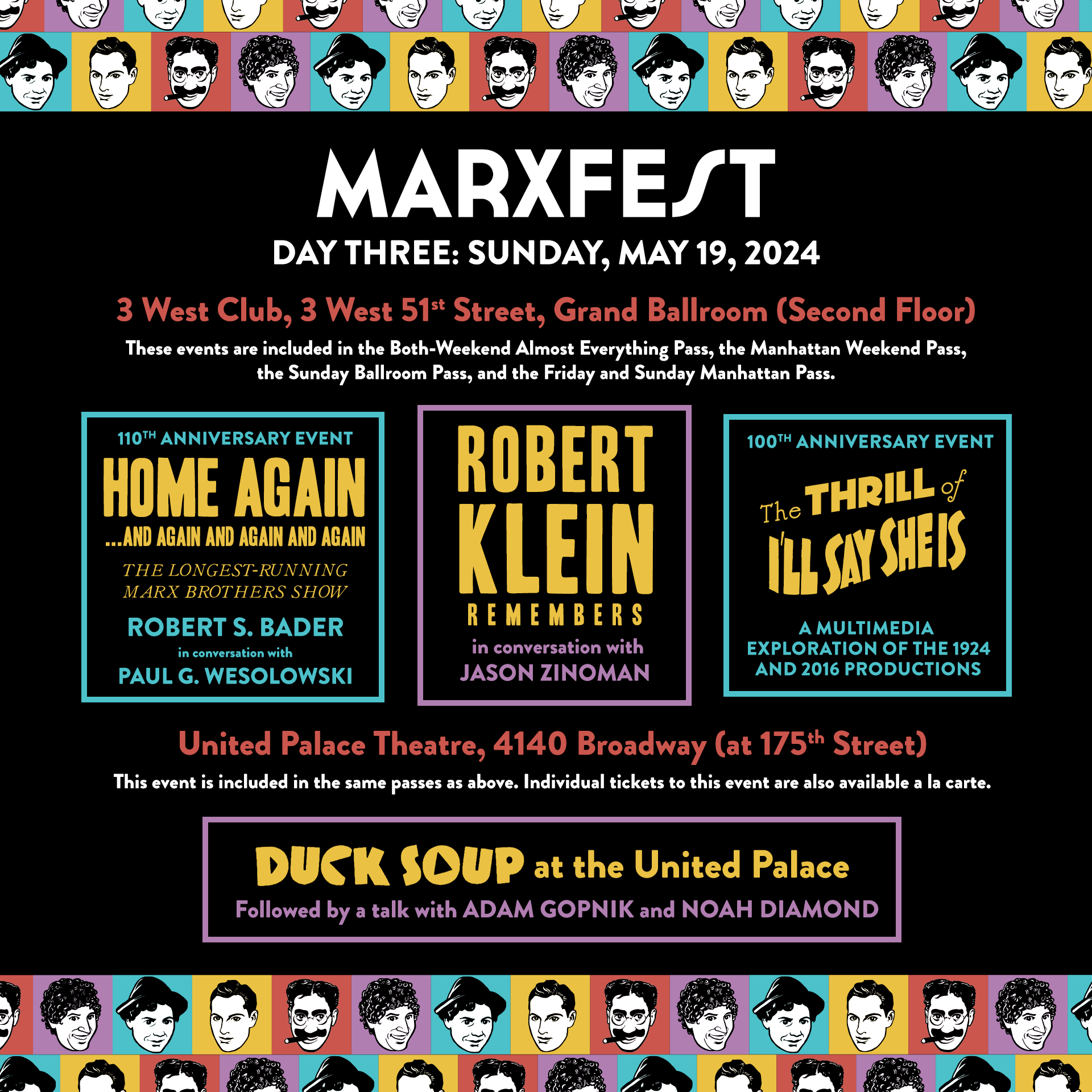 May 19 programming includes Robert Bader’s overview of the Marx Brother’s 1914-15 tour in “Home Again;” a conversation between Jason Zinoman and Robert Klein; a look at I’ll Say She Is with Noah Diamond; and a screening of the 1933 film Duck Soup followed by a talk with Adam Gopnik and Noah Diamond at the landmark United Palace Theatre in Washington Heights.
On May 20, Vince Giordano & The Nighthawks will present “A Night of Marx Brothers Era Music” at Birdland.
From May 24-26, the festival will continue programming on Coney Island. Events will include “An Evening with Marx & Ferrante” (Andy Marx and Frank Ferrante); a burlesque tribute to the Marx Brothers by Jonny Porkpie titled “A Day on the Boardwalk, A Night at the Stripshow;” Robert Farr’s “The Wisecracks Around Here Were Not Appreciated” at the Coney Island Museum; astrologer Kathy Biehl’s “Marxes in the Stars: The Astrology of The Brothers & Their Mother;” Trav S.D.’s “The Marx Brothers, Coney Island, and Sideshow;” a celebration of Harpo Marx’s artistry, and more.
Visit Marxfest.org for more information or to purchase tickets, which go on sale April 2.