Algonquin Round Table History,News Centennial of Abie’s Irish Rose

Centennial of Abie’s Irish Rose

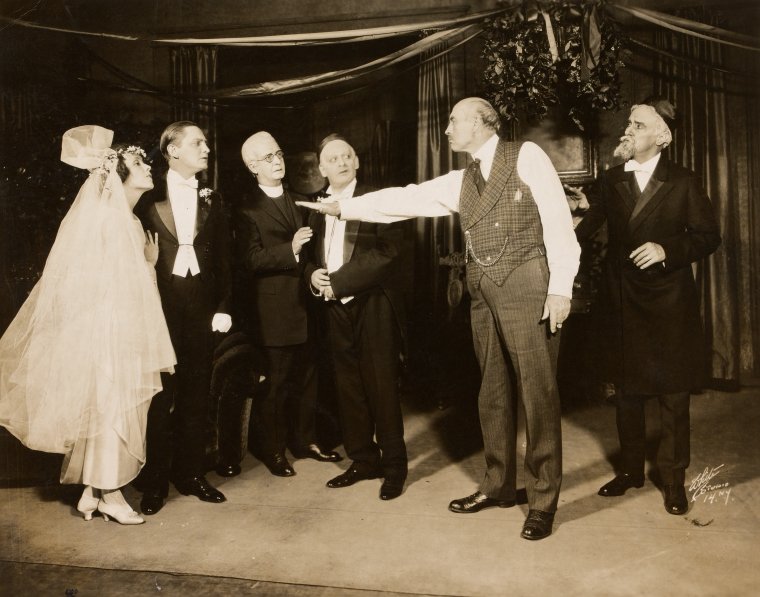
Marie Carroll, Robert Williams, Harry Bradley, Alfred White, John Cope and Howard Lang in scene from Abie's Irish Rose. Credit: Billy Rose Theatre Division, The New York Public Library.

Marie Carroll, Robert Williams, Harry Bradley, Alfred White, John Cope and Howard Lang in scene from Abie's Irish Rose. Credit: Billy Rose Theatre Division, The New York Public Library.

Marie Carroll, Robert Williams, Harry Bradley, Alfred White, John Cope and Howard Lang in scene from Abie’s Irish Rose. Credit: Billy Rose Theatre Division, The New York Public Library.


Today the New York Times published a very thorough and detailed account of the centennial of Abie’s Irish Rose, a hit show 100 years ago that the Algonquin Round Table by turns roasted and scorned. The article quotes Robert Benchley and Alexander Woollcott, with a passing reference to another Vicious Circle member, Harpo Marx.

Opening a few days after St. Patrick’s Day 1922, Abie’s Irish Rose was the miracle show of the decade. Despite withering reviews and serving as the butt of jokes all over town, it ran for 2,327 performances—five years and five months. Anne Nichols wrote the unpretentious comedy allegedly based on a real-life story of a mixed-marriage she heard about. In her story, young Abraham Levy brings home from the war his blushing bride, Rosemary Murphy, a girl he met in France while she was entertaining the doughboys. But knowing how his family would take the news, he introduced her to his parents as Rosie Murpheyski. In the next act the Murphy clan comes over for a visit, and hilarity ensues.

The show appealed to audiences everywhere; at one time six road companies were touring the United States and others were in England and Australia. The playwright raked in more than $6 million and eventually had to cut down on the road companies because the income taxes were crushing her. All the major critics blasted the show, with the exception of Alexander Woollcott. One standout, and long-suffering, reviewer was Robert Benchley. He had to compose a few lines each week for a capsule review in Life. Among his finest gems were, “People laugh at this every night, which explains why democracy can never be a success,” and “Where do the people come from who keep this one going? You don’t see them on the streets in the daytime.”

Dorothy Parker, who is not included in the article, was working for Ainslee’s at the time. She lumped it in with another play of a similar type. In September 1922, she wrote, “And then there came, in quick succession, The Rotters and Abie’s Irish Rose. Despite its having one night’s start on its opponent, The Rotters was defeated by Abie’s Irish Rose for the distinction of being the season’s worst play.”

As the Times points out, no modern theater company is currently interested in a revival of Abie’s Irish Rose. Which may be a good thing.

The Dorothy Parker reviews from the era are collected in Dorothy Parker Complete Broadway, 1918-1923.

Related Post

FPA

Radio Pioneers of the Algonquin Round TableRadio Pioneers of the Algonquin Round Table

CBS

Deems Taylor, composer Sigmund Romberg, and Alexander Woollcott in the studio, circa 1935.

When I was compiling the material for my book, The Algonquin Round Table New York: A Historical Guide, I was struck by the group’s versatility. I’d originally believed the group, which met from 1919 to about 1927, was the realm of newspaper and magazine writers. However, by researching the biographies of all thirty members, it became clear the group had their fingers in every form of mass entertainment and media.

It turns out that there were members with careers that stretched from silent pictures to live television, such as actresses Margalo Gillmore and Peggy Wood. Robert Benchley made the first all-talking short, The Treasurer’s Report, released in March 1928 by Fox. Marc Connelly and Dorothy Parker both wrote captions and scenarios for the silents, then later jumped into writing plays and talkies.

But if there is one format that most of the members drew paychecks from after the Round Table ended, that’s radio. Many members of the group appeared as guests, commentators, writers, or actors. Benchley and Parker had their short stories adapted for dramatizations. Harpo Marx whistled his answers on-air. Others made the transition from newspapers to microphones, trading on their popularity as writers.

The book has more than 100 locations around the New York area tied to the lives of the “Vicious Circle” that met at the Algonquin Hotel on West Forty-fourth Street. Here are three spots from their radio days, all within walking distance of the Round Table.

FPA

New York City Mayor Fiorello La Guardia and Franklin P. Adams on Information Please.


NBC, 30 Rockefeller Plaza

Franklin P. Adams was a veteran newspaper columnist with 35 years’ experience when his services were no longer needed. Radio saved him, and a quiz show was the last hurrah of his brilliant career. In 1937, the Herald Tribune didn’t renew his contract. With an encyclopedic knowledge of literature and trivia and a family of five to support during the height of the Great Depression, the offer to be a regular panelist on a radio quiz show came as a blessing.

The format of Information Please was simple but brilliant. Listeners mailed in questions. If the question stumped a panel of experts, the listener won a small cash prize. The show was unrehearsed and conducted before a live studio audience. The 30-minute program moved like lightning, and experts and guests had to answer quickly. On May 17, 1938, Information Please debuted on the NBC Blue Network (later ABC). Clifton Fadiman, a literary critic who wrote for The New Yorker, was master of ceremonies. The show was an overnight success, and more than 25,000 questions poured into the studios.

One question put to F.P.A. in 1938 was to finish the Joe Miller gag, “Who was that lady I saw you with last night?” To which he replied, “There are two answers: That was no lady, that was my wife. And the other is that was no lady that was your wife.” The show continued for ten years, mostly on NBC. Over time, just about every Round Table member appeared as a guest.

NBC has always been associated with Rockefeller Center. John D. Rockefeller Jr., son of the founder of Standard Oil, owned the land and helped create the landmark. The area bounded by Fifth and Sixth avenues from 48th to 51st streets contained numerous speakeasies before demolition in 1930. NBC has called 30 Rockefeller Plaza home since the building was completed in 1933, spanning corporate ownership from General Electric to Comcast. More than a dozen buildings form the complex today, with “30 Rock” as centerpiece. Radio studios were the original tenants (hence Radio City) and now television studios. The Art Deco buildings are landmarks inside and out.

Carnegie Hall

Carnegie Hall.


CBS, Carnegie Hall, 881 Seventh Avenue

When radio networks became national broadcasters in the late 1920s, some of the live programming was classical music. Symphonies and orchestras dominated as networks tried to reach upper class listeners. William S. Paley signed the New York Philharmonic to CBS in a major coup and gave the network enormous prestige.

Beginning in 1936, Deems Taylor served as commentator during intermissions. Already a star composer and conductor, he had been a newspaper music critic but never a broadcaster. His role at CBS was an enormous success, and Taylor found himself giving weekly music lecturers to a huge audience during Sunday afternoon concerts in Carnegie Hall. He helped listeners understand what they were hearing and helped a generation appreciate classical music. Taylor also introduced listener questions, interviewed orchestra members during intermissions, and brought the whole experience of classical music into the nation’s living rooms. A broadcaster for more than ten years, Taylor became the country’s best-known authority on music.

The building was saved from a wrecking ball in 1960 and underwent multi-million dollar renovations in recent years. Today the Isaac Stern auditorium, the main performance hall, seats 2,800.

CBS, 485 Madison Avenue

Alexander Woollcott loved to pontificate. He was a ham, a showman, and a natural as a radio broadcaster. He also notoriously recycled magazine articles and sold them to two and even three publications. Getting a radio show allowed him to retell those same stories to another audience and saved his career. From 1930 to 1943, Woollcott worked on the top floor in Studio One of the CBS Building. He was “The Town Crier” on panel discussion radio program, with national sponsorships. It was an early form of talk radio, with notable guests brought in and Woollcott acting as a moderator.

On January 23, 1943, a few days after he turned 56, Woollcott suffered a stroke during a live panel discussion. He was carried out of the CBS studios in his chair and brought to Roosevelt Hospital, but it was too late. A week later, a memorial service was held at Columbia University’s McMillan Academy Theatre.

In 1930, the 24-story Columbia Broadcasting Building was completed for the two-year-old CBS radio network at 485 Madison Avenue to designs by J. E. R. Carpenter. This was CBS’s home until 1965, when the company moved to the 38-story CBS Building designed by Eero Saarinen on Sixth Avenue and 52nd Street, nicknamed “Black Rock.”

***

Originally written for Cladrite Radio.

Pulitzer Landmarks Tied to the Algonquin Round TablePulitzer Landmarks Tied to the Algonquin Round Table

This guest blog was written for Literary Manhattan.

I love literary landmarks. I seek them out whenever I possibly can. I’m the kind of person who can’t pass a plaque or historical marker and not stop for a look, and when the site is tied to an author or book, it’s even better. When I was writing my new book, The Algonquin Round Table New York: A Historical Guide, I decided to make it a guidebook to everything related to the Vicious Circle in New York: their homes, offices, speakeasies, theaters, and related locations.

Several of the locations in my book have ties to the Pulitzer family that are shared here. If you have never been to Woodlawn Cemetery, take a trip to the beautiful landmark in the Bronx. The Pulitzer graves are incredibly touching to see placed there.

Here are two in Manhattan that you might want to visit if you get the opportunity. I enjoyed putting them in the book because they show that even though there is no longer a Pulitzer newspaper in the city, his literary landmarks are still around us.

The New Yorker has a long history of sticking its nose into matters of frivolity around New York City, and the magazine loves a good crusade. E. B. White complained vociferously about advertising in Grand Central Terminal, and editor Harold Ross, a commuter, testified at a city hearing against public address announcements in the terminal.

The magazine also took up the cause of the dirty bronze statue of Pomona, goddess of abundance, outside the Plaza Hotel in Grand Army Plaza. When New York World publisher Joseph Pulitzer died in 1912, he bequeathed $50,000 to build it. Carrere & Hastings designed the Italian Renaissance-style fountain, which was dedicated in 1916. But in The New Yorker of April 18, 1931, poet Arthur Guiterman complained that the fountain was a mess. The last stanza of “Letter to Mr. Pulitzer” reads:

One hates to speak this way about a lady,
But she is obviously much too shady;
Though still quite young, a good bit under thirty,
No nymph was ever quite so black and dirty
In all New York; so you, sir, as her guardian
(You see I’m Mid-Victorian, not Edwardian),
Should personally scrub her form and face in
The sudsy foam of her own fountain basin.

A few weeks later the magazine published a response by Pulitzer’s son, Ralph, publisher of the World:

For know! The lady’s guardians ad litem,
Aroused by her attempts to mock and spite ’em,
Have joined the city in a contribution
To give her an immaculate ablution;
To scrub her from her head, with all its wet locks,
Clear down her contours to her very fetlocks.

Ralph Pulitzer donated $30,000 to restore the statue. Doris Doscher, the model who posed for sculptor Karl Bitter as Pomona, wrote to the New York Times: “I want to take this opportunity to offer my thanks to Mr. Pulitzer for enabling me to again stand exalted—and scrubbed—above the grounds on Fifth Avenue, generously spurting precious, clear water—flush, in these times of dried-up prosperity.”

The saga of the statue and Pulitzer Fountain is a long-running city drama. It was renovated in 1971 but, due to faulty plumbing, went dry for six years in the 1980s. In 1989, $3.3 million was raised privately to restore it yet again.

The World stood at 63 Park Row, with editorial offices on the eleventh floor of a tower that Pulitzer erected in 1890. A golden dome topped the 309-foot tall building. Pulitzer died in 1911, and the paper ran along for twenty more years.

Star reporter Herbert Bayard Swope became executive editor in 1921 and brought in the best talent, increasing high-quality reporting and also hiring New York’s first black reporter. By the time the Round Table came to it, the highly respected World was the “newspaperman’s newspaper.” Swope receives credit for creating the page opposite the editorial page—the “Op. Ed.”—a phrase he coined. Onto this page he brought a lively mix of writers, most from the Vicious Circle. Among the first of them to write for the World was Robert Benchley a month after he quit Vanity Fair in 1920. Benchley’s book reviews often had nothing to do with the books themselves and could easily contain ruminations on train schedules.

Swope stole both Heywood Broun and Franklin P. Adams (known as F.P.A.) from the Tribune in 1921. The 33-year-old Broun could write anything, from a play review to a recap of the Harvard-Yale football game. He had free rein in his column “It Seems to Me,” which ran for six years, to discuss books, sports, movies, or politics. The last of these landed him in hot water. When F.P.A. brought his famous “Conning Tower” to the Op. Ed. Page, it caused a sensation. Ralph Pulitzer and his brothers broke the family trust by court order in 1931 and sold the newspaper. It put more than 3,000 people out of work.

Today no plaque or monument marks the former Pulitzer Building and its wonderful gold dome. Before it was razed in 1955, Swope and F.P.A. toured the deserted newsroom one last time. It is now a highway approach to the Brooklyn Bridge. The stained glass windows from the city room were moved to Columbia University’s Journalism School building, 2950 North Broadway, where, each year in the World Room, the Pulitzer Prize winners are announced.

Heywood Broun on Babe Ruth in 1922Heywood Broun on Babe Ruth in 1922

With baseball season around the corner, let’s look at one of the many Algonquin Round Table links to the game. In the world of New York newspaper columnists in the Jazz Age, Heywood Broun stood out from the rest. His column “It Seems To Me” was beloved, and he could tackle any subject. Broun had gotten his start as a baseball writer, and continued his passion for ballpark trips even when he became a celebrity covering Broadway and news stories. Broun had seats in the press box to watch Babe Ruth in his amazing 1921 season with the New York Yankees. This column appeared in 1922.

Ruth Vs. Roth
By Heywood Broun

We picked up “Who’s Who in America” yesterday to get some vital statistics about Babe Ruth, and found to our surprise that he was not in the book. Even as George Herman Ruth there is no mention of him. The nearest name we could find was: “Roth, Filibert, forestry expert; b. Württemberg, Germany, April 20, 1858; s. Paul Raphael and Amalie (Volz) R., early edn. in Württemberg—”

There is in our heart not an atom of malice against Prof. Roth (since September, 1903, he has been “prof. forestry, U. Mich.”), and yet we question the justice of his admission to a list of national celebrities while Ruth stands without. We know, of course, that Prof. Roth is the author of “Forest Conditions in Wisconsin” and of “The Uses of Wood,” but we wonder whether he has been able to describe in words uses of wood more sensational and vital than those which Ruth has shown in deeds. Hereby we challenge the editor of “Who’s Who in America” to debate the affirmative side of the question: Resolved, That Prof. Roth’s volume called “Timber Physics” has exerted a more profound influence in the life of America than Babe Ruth’s 1921 home-run record.

Heywood Broun

Heywood Broun

The question is, of course, merely a continuation of the ancient controversy as to the relative importance of the theorist and the practitioner: should history prefer in honor the man who first developed the hypothesis that the world was round or the other who went out and circumnavigated it? What do we owe to Ben Franklin and what to the lightning? Shall we celebrate Newton or the apple?

Personally, our sympathies go out to the performer rather than the fellow in the study or the laboratory. Many scientists staked their reputations on the fact that the world was round before Magellan set sail on the Vittoria. He did not lack written assurances that there was no truth in the old tale of a flat earth with dragons and monsters lurking just beyond the edges.

But suppose, in spite of all this, Magellan had gone on sailing, sailing until his ship did topple over into the void of dragons and big snakes. The professors would have been abashed. Undoubtedly they would try to laugh the misfortune off, and they might even have been good enough sports to say, “That’s a fine joke on us.” But at worst they could lose nothing but their reputations, which can be made over again. Magellan would not live to profit by his experience. Being one of those foreigners, he had no sense of humor, and if the dragons bit him as he fell, it is ten to one he could not even manage a smile.

By this time we have rather traveled away from Roth’s “Timber Physics” and Ruth’s home-run record, but we hope that you get what we mean. Without knowing the exact nature of “Timber Physics,” we assume that the professor discusses the most efficient manner in which to bring about the greatest possible impact between any wooden substance and a given object. But mind you, he merely discusses it. If the professor chances to be wrong, even if he is wrong three times, nobody in the classroom is likely to shout, “You’re out!”

The professor remains at bat during good behavior. He is not subject to any such vicissitudes as Ruth. Moreover, timber physics is to Mr. Roth a matter of cool and calm deliberation. No adversary seeks to fool him with speed or spitballs. “Hit it out” never rings in his ears. And after all, just what difference does it make if Mr. Roth errs in his timber physics? It merely means that a certain number of students leave Michigan knowing a little less than they should—and nobody expects anything else from students.

On the other hand, a miscalculation by Ruth in the uses of wood affects much more important matters. A strike-out on his part may bring about complete tragedy and the direst misfortune. There have been occasions, and we fear that there will still be occasions, when Ruth’s bat will be the only thing which stands between us and the loss of the American League pennant. In times like these who cares about “Forest Conditions in Wisconsin”?

Coming to the final summing up for our side of the question at debate, we shall try to lift the whole affair above any mere Ruth versus Roth issue. It will be our endeavor to show that not only has Babe Ruth been a profound interest and influence in America, but that on the whole he has been a power for progress. Ruth has helped to make life a little more gallant. He has set before us an example of a man who tries each minute for all or nothing. When he is not knocking home runs he is generally striking out, and isn’t there more glory in fanning in an effort to put the ball over the fence than in prolonging a little life by playing safe?

***

Adapted from The Lost Algonquin Round Table: Humor, Fiction, Journalism, Criticism and Poetry From America’s Most Famous Literary Circle (Donald Books/iUniverse). Edited by Nat Benchley and Kevin C. Fitzpatrick. Available Here.