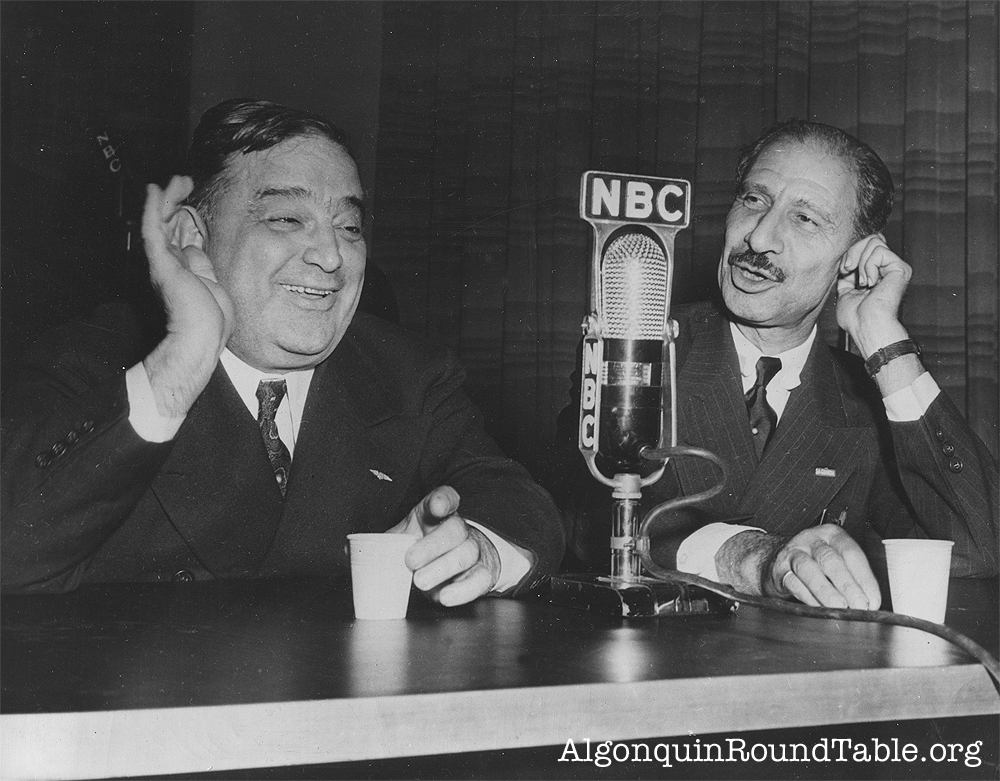
Today is the natal day of Franklin P. Adams, born on this day in 1881 in Chicago. During his days in New York City, he famously had joint birthday parties with his pal and poker-playing friend, George S. Kaufman (Nov. 16). There are many, many stories about FPA online and in The Lost Algonquin Round Table and The Algonquin Round Table New York: A Historical Guide. But there is news today, on his birthday.
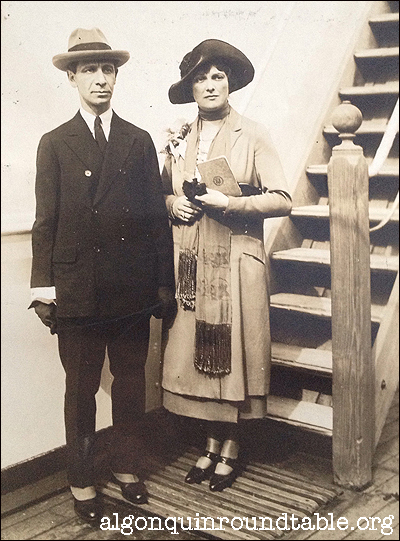
Franklin P. Adams and his second wife, Esther Root, on their honeymoon, 1925.
Recently I was given the huge honor by the descendants of FPA to safeguard his papers and archives. Tony Adams, last surviving son of FPA and his second wife, Esther Root Adams, gave to me FPA documents, letters, photographs, and ephemera. I will be using some of that material for my next book, The Lost Algonquin Round Table 2, due out late next year. One thing about FPA, he saved everything. So on this birthday, raise a cocktail to FPA. He deserves to be remembered today and every day. Look for his books on eBay and in used book stores. He has been out of print since the 1960s, which is pretty sad to me. If you are a fan of FPA, drop me a line.
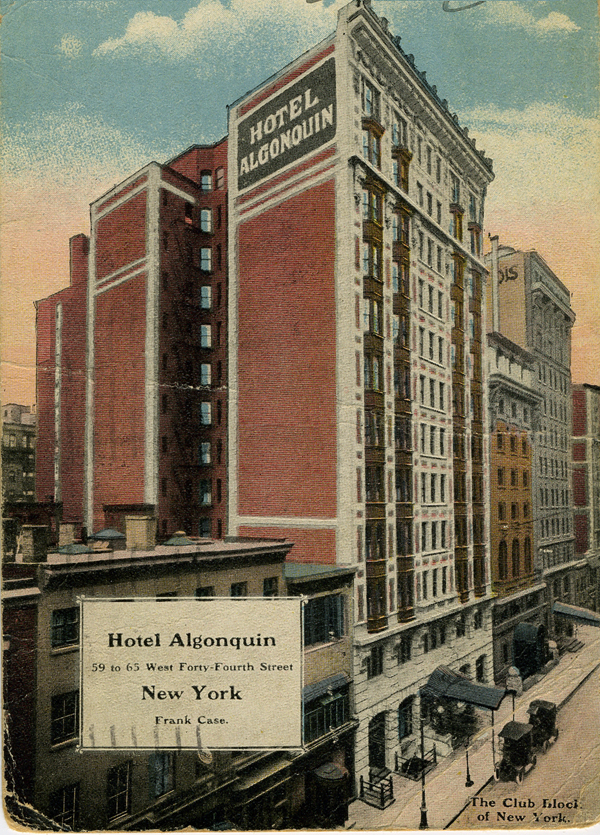
Today is the anniversary of the opening of the Algonquin Hotel in 1902. Guests 117 years ago checked into the newest hotel on the block, located at No. 59-63 West Forty-fourth Street. When the Vicious Circle launched a century ago in 1919, it was but just 17 years old.
For the 2015 book The Algonquin Round Table New York: A Historical Guide (Globe Pequot), an entire chapter is devoted to the history of the hotel, its ownership era, and legends. A brief excerpt about the early days in 1902 begins:
“It isn’t the oldest hotel on the block. Both the Royalton at No. 44 and the Iroquois at No. 49 opened in 1900. In 1901-1902 the Thompson-Starrett Company built the Algonquin Hotel for the Puritan Realty Company. Puritan bought the plot, 72 x 100 feet, for $180,000 in November 1901. Construction of the one-hundred thirty-six foot tall building took just seven months. Puritan Realty put up the money, $500,000, and Thompson-Starrett acted as the architects and contractors. Twenty-eight year-old architect Goldwin Starrett worked on the hotel with his brothers Theodore, Ralph, and William.
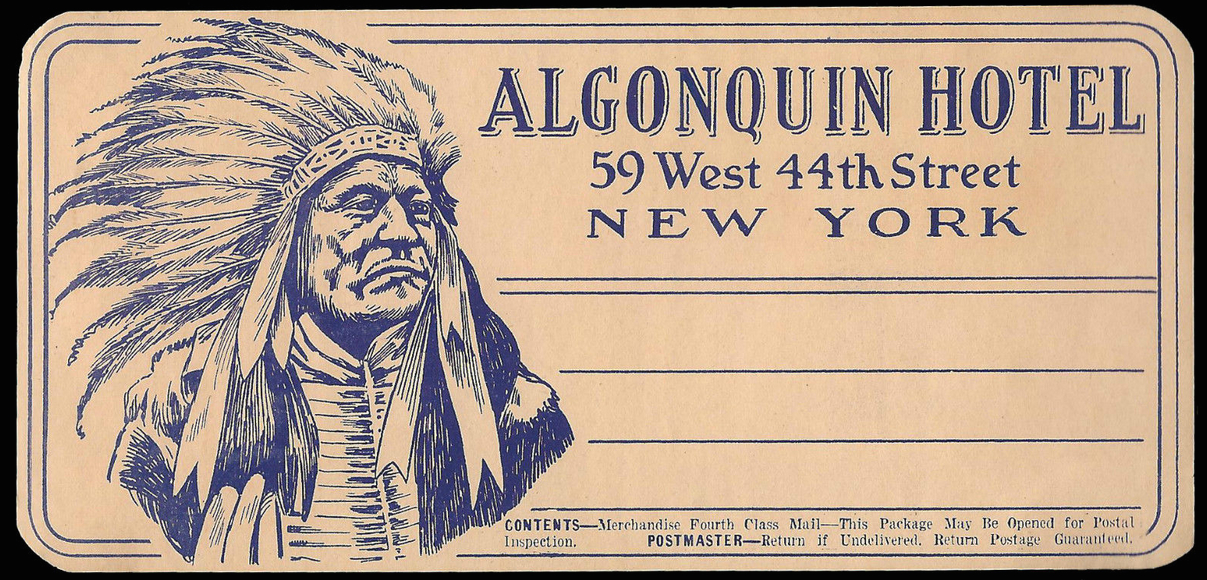
It opened as the Hotel Algonquin, named for the Native Americans who were populous in New England during the pre-colonial era. “Algonquin” was chosen at the suggestion of first owner Ann Stetson Foster, because the Hotel Iroquois was already next-door. “It will make a veritable Indian settlement,” she said.
The first guests checked in on November 22, 1902. The twelve-story hotel had 192 rooms and suites. A room and bath en suite cost $2 a day, while a three-bedroom suite with private hall, sitting room, dining room, three bathrooms, and library would set you back $10. Following extensive renovations in 2012, the hotel now has 181 rooms; of those 25 are suites.”
The hotel is local and national literary landmark. We lift a glass to its continued history, success, and achievements. Here is a great podcast recorded inside the hotel by Greg and Tom, The Bowery Boys.
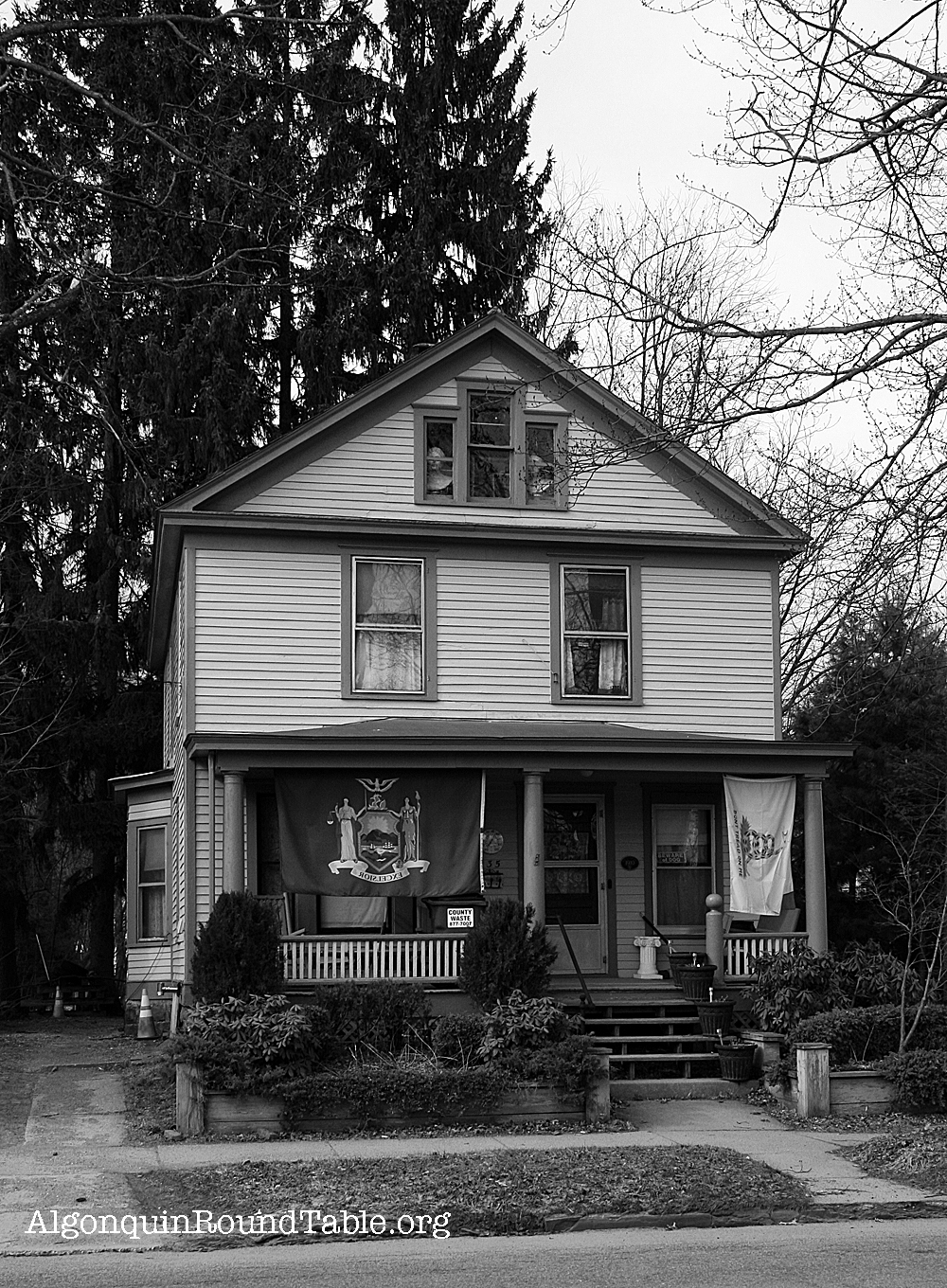
After the demise of the New York World in 1931, Algonquin Round Table member Frank Sullivan moved home to Saratoga Springs and became the ultimate freelancer. In a small clapboard house shared with his sister at 135 Lincoln Avenue, he turned out marvelous humor pieces for the rest of his career. “Once I visited New York for twenty years but I wouldn’t live there if you gave me Philadelphia,” he wrote. “A small town is the place to live. I live in a small town 180 miles from New York and while I would not say it has New York beat by a mile I would put the distance at six furlongs.”
Over the years, New Yorkers such as Harold Ross and Marc Connelly visited Sullivan, who took them to the racetrack, two blocks from his house, which treated him like royalty. He picked up the nickname “The Sage of Saratoga” and worked until his early eighties. He wrote for The New Yorker for fifty years as well as the Times sports section, the Saturday Evening Post, and Town & Country, his work collected in half a dozen books.
Sullivan suffered a series of falls in his home, and his health deteriorated. He died in Saratoga Hospital on February 19, 1976, at age 83. He is buried in the family plot St. Peter’s Cemetery in Saratoga Springs.
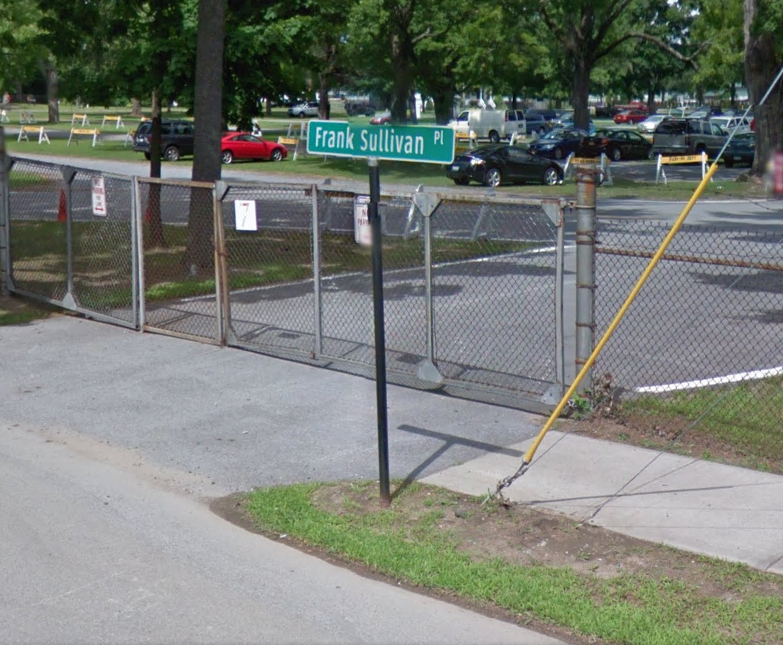
Frank Sullivan Place
Today he is immortalized with a street sign nearby the racetrack, Frank Sullivan Place. His house was named a literary landmark, and is privately owned.
Adapted from The Algonquin Round Table New York, A Historical Guide (Globe Pequot Press) available here.
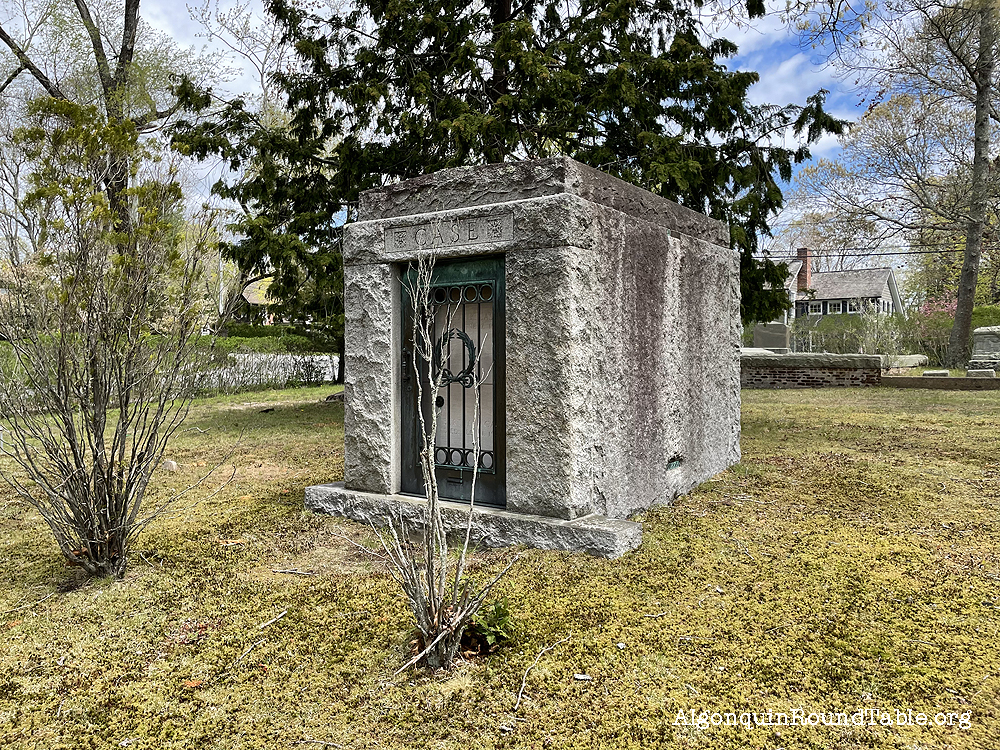
I found Frank Case. I wasn’t even looking for him. I was in Oakland Cemetery in Sag Harbor, Long Island, for the first time. I was actually looking for a Doughboy for our WWI Homecoming 21 project. As I was walking along the line of graves, since I didn’t know the location, I was peering at each one as quickly as possible. At the corner of the cemetery, in the corner of my eye, was a lone mausoleum. There are not that many in Oakland, just a few, it is not Woodlawn. As I stepped closer I saw the name across the top: CASE.
I was so happy to see this. Here was the general manager and owner of the Algonquin Hotel.
I had known for many years that Case (1871-1946) had a second home in Sag Harbor. He wrote about the home in his books, as did his only daughter, Margaret Case Harriman. While Case was the most famous hotelier in America at one time, I never knew where he ended up after his death in Manhattan. I assumed, wrongly, that he had gone home to Buffalo, New York, his hometown, and where his first wife, Carrie Case, was buried in 1908 after she tragically died in the Algonquin Hotel following the birth of their son, Carrol.
Frank and Bertha Case
One thing I learned a long time ago was to never trust the Internet. When I was researching my book The Algonquin Round Table New York: A Historical Guide (2015) I was on a mission to track down the final resting places of the Vicious Circle. I did locate almost all 30 of them, but there are a few that still escape me (where are you Jane Grant and Robert E. Sherwood?). But I found many inaccuracies and misinformation. I made a pass at looking for Case; one lead was he was buried in Woodlawn, which was wrong. Many obituaries list New Yorker’s would hold their memorials in Woodlawn, then the remains sent away to other towns for burial. What I suspect is after his death, which was just four months after his second wife, Bertha, his family brought Bertha and Frank to the receiving vaults of Woodlawn. Here they remained temporarily while the mausoleum was constructed in Sag Harbor. I guess if I had 10 hours of free time I could check the records of both cemeteries, so perhaps if someone reading this wants to hire me for a paid assignment I will do that.
I like finding this mausoleum and closing the circle on Frank Case, who was by all accounts beloved by friends and staff (but was anti-union). He was also, like me, a member of The Lambs (the clubhouse was 2 minutes away west on Forty-fourth Street, and many of the actors who were members also lived at the hotel, such as John Drew and nephew John Barrymore).
One story told in the obituary of Bertha Case is about Sag Harbor. Bertha was a housekeeper at the Algonquin, which is how she met Frank. During WWI she volunteered and went to France with the YMCA as a volunteer, and was friends with superstar Elsie Janis (also an Algonquin regular). She and Frank were married for 30 years. What Bertha did was use the flower gardens at the Sag Harbor house to provide floral arrangements for the hotel–which she oversaw. Sag Harbor is also where the Case family entertained friends, such as Robert Benchley.
If you are in Sag Harbor and the South Fork of Long Island, pay a visit to Frank and Bertha Case.